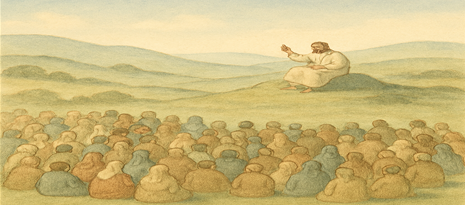
Text: Matthew 5:1–12
Today’s passage opens the section commonly known as the Sermon on the Mount — Matthew chapters 5 through 7 — and more specifically, the famous declaration of the Eight Beatitudes.
Many years ago, when I was a first-year undergraduate student, I was assigned to read a book on the Sermon on the Mount written from the perspective of systematic theology. I had to write a review and present it publicly.
And if I try to remember honestly what I felt at the time, the Sermon on the Mount seemed almost impossible to decipher.
It felt like a cryptic code.
More than that, it did not feel like an ethic that could actually be lived. It felt like an impossible standard deliberately placed beyond the reach of ordinary human beings.
Now, looking back after decades — having studied both systematic theology and biblical theology for many years — I realize something different.
The question of whether the ethics of the Sermon on the Mount are fully achievable in actual life still remains an unresolved mystery.
But the text itself is not as incomprehensible as I once thought.
In truth, many of the difficulties surrounding the Sermon on the Mount arise because interpreters often attempt to force the text into rigid systematic categories without sufficiently respecting the findings of biblical theology.
And when that happens, both the writer and the reader easily become trapped in a theological maze.
Therefore, before directly discussing the Beatitudes themselves, I want first to reflect upon the significance of these declarations as the introduction to the entire Sermon on the Mount.
In order to properly interpret this text, three fundamental questions must first be asked:
◾ Who is speaking?
◾ To whom is this being spoken?
◾ And what exactly is being said?
Only after wrestling with these questions can we begin approaching the heart of the Sermon on the Mount.
Who Is Speaking?
The first question is simple.
Who is the speaker?
The answer appears obvious:
Jesus.
These are the teachings spoken by Jesus Himself in the region of Galilee sometime between AD 25 and 30.
Jesus is the first speaker.
And yet even this obvious point matters enormously.
Because the Sermon on the Mount is not merely a collection of ethical sayings from a religious philosopher. It is not abstract moral advice detached from existence.
These are the words of the One who embodies the Kingdom He proclaims.
To Whom Is Jesus Speaking?
The second question is equally important.
Who are the listeners?
If we carefully examine Matthew 5:1, we discover something often overlooked.
The audience is not simply “the crowds.”
The text specifically says:
“His disciples came to Him.”
The recipients of the Sermon on the Mount are not merely curious listeners gathered around Jesus hoping for miracles, healing, or interesting teachings.
They are disciples.
People who accepted the burden of Jesus’ destiny as their own.
People who sought to imitate His words, His character, His life, and His way.
But here another important distinction must be made.
The “disciples” in Matthew 5 are not identical to the later group commonly called “the Twelve Apostles.”
Matthew deliberately uses different expressions.
The general disciples are called:
hoi mathētai — “the disciples.”
But the Twelve are later designated separately.
This matters greatly.
Because the Sermon on the Mount is not directed only toward a small, elite circle of specially appointed apostles.
The ethical demands of the Kingdom are not restricted to a spiritual aristocracy.
They are directed toward all who follow Jesus.
And here we encounter something even more significant.
The Gospel writers often projected their own church communities into the narratives they recorded.
Why?
Most likely to strengthen and encourage believers living under pressure, suffering, and persecution.
For example, in the Gospel of Mark, the “crowd” surrounding Jesus often functions as a reflection of Mark’s own church community.
Likewise, in Matthew’s Gospel, the term “disciples” frequently reflects Matthew’s own believing community.
In other words, when Matthew records Jesus speaking to “the disciples,” he is not merely referring to a handful of individuals standing physically on a Galilean hillside decades earlier.
He is also speaking to the Matthew community of the 80s AD.
And beyond them, to all Christians who would later follow Jesus.
This means the Sermon on the Mount is not optional.
It is not an ethic reserved for pastors, monks, missionaries, or extraordinary saints.
It is addressed to every Christian.
To anyone who dares to call Jesus “Lord.”
And therefore every believer carries responsibility for these teachings.
No one escapes.
No one is exempt.
And here we must be careful.
The Sermon on the Mount is not a ladder by which people earn salvation.
It is the ethical shape of a life already touched by grace.
It is not the condition for becoming saved.
It is the responsibility of those who already belong to Christ.
What Is Jesus Actually Saying?
Now we arrive at the final question.
What is Jesus saying?
And honestly, this is where many people experience something close to collapse.
If we slowly and carefully read Matthew chapters 5 through 7, we quickly realize the enormous gap between the ethics Jesus demands and the actual condition of our lives.
The distance is overwhelming.
At times the commands even seem impossible.
◾ Do not merely avoid adultery — do not even lust in your heart.
◾ Do not retaliate.
◾ Love your enemies.
◾ Do not publicly display your righteousness.
◾ Do not perform prayer or fasting for recognition.
◾ Do not be consumed by anxiety about survival.
And suddenly we realize:
The Sermon on the Mount directly collides with nearly every instinct we inherited from society.
Everything we learned through family,
through education,
through culture,
through competition,
through survival,
through social experience,
through ambition,
through fear —
all of it points us toward one understanding of happiness.
But Jesus destroys that entire framework.
The Beatitudes announce a radically different definition of what it means to live a blessed and happy life.
The Greek word translated “blessed” is makarioi.
It refers not merely to a fortunate individual, but to someone existing in a state of genuine flourishing and happiness.
And yet the conditions Jesus associates with this happiness appear absurd according to ordinary human standards.
◾ The poor are blessed.
◾ Those who mourn are blessed.
◾ The meek are blessed.
◾ Those who hunger and thirst are blessed.
◾ The merciful are blessed.
◾ The persecuted are blessed.
None of this makes sense according to conventional definitions of happiness.
Even the explanations following each declaration seem insufficient according to worldly logic.
Blessed are the poor?
Because theirs is the Kingdom?
Blessed are those who mourn?
Because they will be comforted?
Blessed are the persecuted?
Because their reward is in heaven?
From the perspective of ordinary human instinct, these statements sound almost irrational.
And this leads us to a crucial question:
Why does Jesus begin the entire Sermon on the Mount by redefining happiness itself?
Why place these declarations at the very front of His ethical teaching?
Why does Jesus first attack our definition of blessing before commanding anything else?
The answer, I believe, is this:
Because unless our understanding of happiness is fundamentally reoriented, we can never truly follow Jesus.
As long as we define happiness according to fullness, security, success, recognition, comfort, wealth, and visible satisfaction, the life Jesus commands will always appear unbearable.
Impossible.
Even foolish.
Think about it.
Someone strikes you — and instead of retaliating, you turn the other cheek.
You are told not merely to tolerate your enemies, but to love them.
You are wounded unfairly, yet commanded not to seek revenge.
You give generously, yet are told never to display your generosity publicly.
You fast passionately before God, yet are forbidden from drawing attention to it.
You suffer lack, uncertainty, and instability — yet are commanded not to surrender to anxiety.
From the perspective of ordinary definitions of happiness, such a life appears miserable.
And this is precisely why Jesus begins by reorienting the meaning of blessedness itself.
Because unless our concept of happiness is dismantled and rebuilt, we will never endure the actual path of discipleship.
Following Jesus is not completed merely by attending church, performing religious duties, or participating in church systems.
To follow Jesus means carrying the burden of His destiny within the concrete realities of social life.
It means imitating — even copying — His character, His ethics, His actions, and His way of existing within the world.
And this becomes impossible unless our understanding of happiness itself is transformed.
Perhaps much of the confusion, frustration, compromise, and spiritual exhaustion experienced by modern Christians emerges precisely from this collision:
The collision between the happiness we inherited from the world —
and the happiness proclaimed by Jesus.
Therefore, as Christians living within society, we must fundamentally reexamine what we call blessing.
We must reorient our understanding of happiness.
Otherwise, the ethics of the Kingdom will forever remain impossible ideals hanging above our heads.
And so through today’s reflection, may all of us gradually allow our thoughts, values, and desires to be reoriented according to the happiness Jesus Himself proclaims.
And may we increasingly become people who follow Him more fully — not merely in confession, but in actual life.
I pray this in the name of Jesus Christ.