■ Rejecting the Comfortable Refuge of Dualism
Unlike much of the religious thoughts and philosophies of its time, Christianity affirmed the material world. In doing so,it introduced significant complexity into its way of interpreting and explaining reality.
The Incarnation of God—the Word becoming flesh—and the resulting affirmation of the material world marked a decisive departure from the dualistic worldviews prevalent in Egyptian, Greek, and Mesopotamian civilizations. For those who regarded the phenomenal world as a mere “shadow” or “prison,” the Christian proclamation offered an entirely new point of departure and a profoundly provocative perspective.
■ Facing Evil: The Loss of ‘Interpretive Convenience
However, this distinctive stance demanded a painful cost: the loss of an interpretive convenience that surrounding cultures had refined and relied upon for millennia.
If matter is inherently evil or inferior, explaining the tragedies of the world becomes remarkably simple. One can dismiss suffering by saying, “It is simply the nature of matter.” But if the material world—fashioned by a good Creator—is itself good, then from where do suffering and absurdity arise?
By foreclosing the attractive escape offered by Dualism, Christianity willingly assumed the responsibility of interpreting the world while confronting its deepest contradictions. At the very center of this struggle stands the question of the origin of evil.
■ Gnosticism: The ‘Easiest Defense’ to Protect God
Even Gnosticism, later condemned as heretical, may be understood as a profoundly human attempt to evade this burden. In order to avoid attributing evil to God, it denied the goodness—indeed, the reality—of matter itself.
In this sense, Gnosticism chose the easiest and most convenient apologetic route for preserving divine holiness. Yet while it safeguarded God by sacrificing the world, orthodox theology stepped into the agony of explanation, determined to hold together both the holiness of God and the goodness of the material world.
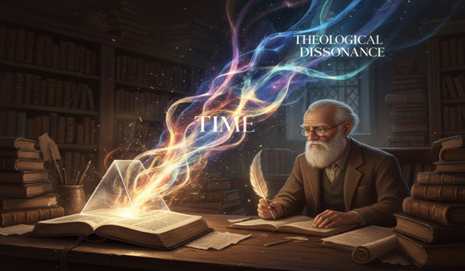
■ The Theologian’s Destiny: Straightening the Refracted Time
Upon deeper reflection, the source of this anguish converges into a single point—echoed by several existentialist philosophers and theologians:
“When the Order of Eternity entered into Time, everything became twisted and refracted.”
This sacred distortion—which occurs when the Infinite clothes itself in the finite—is a wrinkle that human reason alone cannot easily smooth out. Yet to confront this distortion without turning away, and to patiently straighten it for fellow believers, is the fateful vocation of the theologian and of all who walk the path of theology.