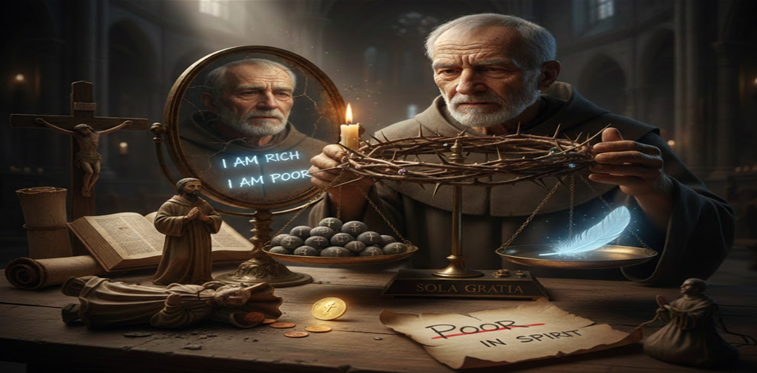
Text: Matthew 5:1–3, Luke 6:20
Part 3: Matthew’s Poverty of Spirit: The Trap of Spiritual Elitism
Beyond Inner Piety
Matthew’s version, “Blessed are the poor in spirit,” has often been misinterpreted as a purely internal or psychological state, disconnected from reality. However, a deeper analysis reveals that Matthew is addressing a very specific challenge within his community. It wasn’t that he was trying to make the message “easier” for the wealthy; If that were his intention, he would have softened other hard sayings—such as the image of a camel passing through the eye of a needle.
The Challenge for the “Spiritual Elites”
The primary target of Matthew’s message was likely the “spiritual elites” within the Jesus movement itself—those who had taken Jesus’ radical calls to voluntary poverty literally. These were the disciples who had sold their possessions and followed Jesus with an intense, disciplined zeal. While their commitment was admirable, it carried a hidden danger: the “the pride of spiritual achievement”—a subtle belief that their sacrifices had earned them a greater share of God’s grace.
The Definition of Spiritual Bankruptcy
To be “poor in spirit” is to acknowledge a state of “spiritual bankruptcy.” It is the realization that no matter how much we sacrifice, pray, or serve, we have no inherent claim on God’s favor. It is the posture of the tax collector who beats his breast and cries for mercy, standing in stark contrast to the Pharisee who lists his religious accomplishments as a reason for his standing before God.
Dismantling Religious Ego
Matthew’s Beatitude functions as a tool to dismantle the religious ego. It reminds us that grace, by definition, cannot be a reward for our efforts or a “conquest” of our willpower. Even the most dedicated disciple must come to God as a “beggar in spirit,” recognizing that their spiritual life is entirely sustained by the unmerited favor of the Father.
The Personal Face of Spiritual Pride
To be “poor in spirit” is not a romanticized humility; it is the painful dismantling of our religious ego.
I recall a time when I looked at a young teacher in my Sunday school with pure disdain. She would spend her Saturday nights drinking and then sleep through the Sunday service, only waking up to teach her lesson. When she later announced she wanted to study theology, I was consumed by what I told myself was a “holy” rage. “How dare you?” I thought. “I have disciplined myself, suffered, and prepared for this path with blood and sweat. Your desire for theology is an insult to me.” This is the quintessential face of the “Spiritual Elite”—believing that our efforts and sacrifices give us a superior claim to God’s grace.