The Heroic Rebel: Was the Serpent an Enlightener?
Intro
In our previous post, we stood before a wave of unsettling questions. If the fruit of knowledge led to maturity and moral autonomy, then a provocative possibility emerges: Was the Fall not a collapse, but a leap forward?
This question is hardly new. Across history, certain thinkers and mystical movements have revisited the Garden and seen not a tragedy of disobedience, but a bold struggle for liberation.
The Myth of Prometheus
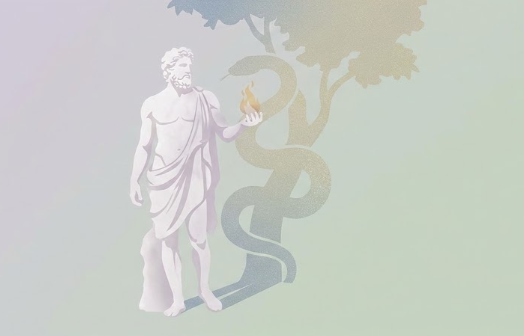
In Greek mythology, Prometheus stole fire from the gods and gave it to humanity. For this defiance of the divine order, he was condemned to eternal punishment—yet he is remembered as a cultural hero, the one who ignited human civilization.
Viewed through this lens, the Serpent can begin to resemble a shadow of Prometheus. Is he the bringer of forbidden “fire”—the spark of self-awareness?
In various literary and philosophical traditions, the rebel who challenges a restrictive authority is often recast as a tragic hero rather than a villain. The line between transgression and liberation becomes blurred.
The Gnostic Vision: The Serpent as Savior
This “rebel narrative” reached a striking expression in certain ancient Gnostic sects. They proposed a radical inversion: the Creator was not the supreme source of light, but a lesser being who restricted knowledge, while the Serpent functioned as a revealer of higher truth.
Within this framework, eating the fruit was not rebellion but awakening—the first step toward escaping the confines of a limited world.
The Seductive Appeal
Such interpretations are intellectually alluring. They transform the shame of the Fall into the pride of progress. They offer an elegant escape from the theological maze we explored earlier.
But after thirty years of sustained engagement with the Hebrew text and the earliest translations, I must ask a more careful question:
Is this “heroic rebellion” truly rooted in the text itself?
Or does it reflect something within us—a deep desire for autonomy projected back onto the story?
Closing
The Promethean lens is compelling. It is beautiful. It feels modern.
But beauty does not guarantee accuracy.
In the next post, we will set aside these interpretive lenses and return to the text—slowly, carefully, word by word. There we will encounter a small linguistic detail whose implications are far more disruptive than any myth.
And it changes everything.