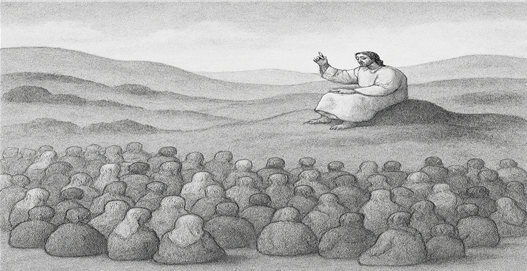
Text: Matthew 5:1–3, Luke 6:20
Introduction: The Wisdom of Contextualization
To begin today’s sermon, I would like to offer a simple hypothesis and pose a question based on it.
Imagine that the educators of seven different church departments agree to preach on a single passage—Matthew 5:1–12—under one shared theme: “The Ethics of the Kingdom of God.”
Even with the same text and theme, should the sermons be identical for every age group? Should a sermon for toddlers be structured in the same way as one for young adults? Of course not. Any responsible educator understands that communication must be shaped by the listener’s stage of life.
This is not a compromise of truth. It is the wisdom of application—ensuring that the Word of God truly reaches the hearts of its hearers.
A preacher never speaks to an abstract or unspecified audience. A preacher always speaks as a member of a specific faith community, taking into account the congregation’s economic realities, educational background, family structures, and social context.
Would an illustration about stock market investments resonate with a rural farming community? Or would metaphors of sowing and harvesting speak more deeply to an urban congregation? The composition of any sermon is inseparable from one central question:
Who is the audience?
Part 1: The Gospel Writers as Preachers
I emphasize this point because the Gospel writers themselves stood in the same position as preachers.
When we read the Gospels through this lens, many interpretive difficulties begin to dissolve. Matthew, Mark, Luke, and John did not merely record history; they preached Jesus to their communities. They received the traditions and oral memories of Jesus and shaped them pastorally so that the Word could take root within their specific congregations.
This is why we encounter different emphases in the Gospel accounts.
Consider the currency units mentioned. In Mark and Luke, we frequently find smaller denominations such as the lepton and the denarius, reflecting communities of modest economic means. Matthew, by contrast, includes references to talents and gold, suggesting a congregation operating within a much larger economic scale.
These differences are not contradictions or errors. They are evidence of pastoral wisdom—of translating Jesus’ message into the lived language of the people.
This background is essential for understanding why Matthew speaks of “poverty of spirit” while Luke speaks simply of “poverty.”
Part 2: Luke’s Version — The Radical Blessing of the Beggar
In Luke 6:20, Jesus declares:
“Blessed are you who are poor,
for yours is the kingdom of God.”
The Greek word Luke uses for “poor” is ptōchos—a term that refers not merely to low income, but to a beggar: one who is utterly destitute and entirely dependent on others for survival.
This statement would have sounded shocking to Jesus’ contemporaries.
In much of the Old Testament tradition, prosperity was interpreted as a sign of God’s favor, while poverty and misfortune were often viewed as evidence of divine judgment—an assumption famously voiced by Job’s friends.
Jesus overturns this logic entirely. He declares that those who are materially marginalized are precisely the ones who stand within God’s favor, love, and trust.
Who, then, is most disturbed by Luke’s words? Both those who obsessively chase wealth and those who already possess it and seek to protect it.
Luke’s Beatitude confronts what we might call materialistic faith—the tendency to follow Jesus primarily for earthly success and visible blessings. It announces a reversal of values, revealing that God’s kingdom advances most powerfully among those whom the world has dismissed.
Part 3: Matthew’s Version — Dismantling Spiritual Elitism
Now we turn to Matthew 5:3:
“Blessed are the poor in spirit.”
Some suggest that Matthew added “in spirit” to soften the message for the wealthy. But this interpretation does not hold. If Matthew wished to comfort the rich, he would not have preserved Jesus’ command to the rich young ruler to sell everything and follow Him.
Rather, Matthew addresses a different danger.
The “poor” in Matthew’s community were likely those who had taken Jesus’ radical call with utmost seriousness—disciples who practiced voluntary poverty, discipline, and sacrifice. Yet with that devotion came a subtle temptation: spiritual pride.
Their sacrifices became a source of self-assurance. They began to believe that their discipline placed them closer to God than others.
Matthew’s phrase “poor in spirit” dismantles this illusion. It calls even the most devoted believer to acknowledge spiritual bankruptcy—the recognition that no amount of sacrifice, prayer, or obedience gives us a claim on God.
This is the posture of the tax collector who cannot lift his eyes to heaven and cries out for mercy. Grace, Matthew reminds us, is not a trophy earned by effort, but a gift given to those who know they have nothing of their own to offer.
I confess that I have personally fallen into this trap.
Early in my ministry, there was a young teacher who had graduated from a prestigious women’s university. She often drank late into Saturday night and slept through Sunday worship, waking only in time to teach her class.
When she later told me she intended to enter seminary, I felt an intense surge of anger. My thoughts were harsh and unfiltered:
“How dare someone like you study theology? Do you know how much discipline, sacrifice, and suffering this path demanded of me?”
In that moment, grace had ceased to be a gift. It had become something I believed I had earned.
This is the heart of spiritual elitism.
Conclusion: Facing Our Discomfort
Luke confronts those who anchor their security in material wealth. Matthew confronts those who anchor their identity in spiritual achievement.
So I ask you: Which version makes you more uncomfortable?
That discomfort is not accidental. It reveals the precise place where we resist the reign of God—where we still attempt to secure our lives through wealth, discipline, or moral superiority.
Jesus calls us beyond both materialistic faith and elitist faith. He calls us to become citizens of the Kingdom—people empty enough to be filled by Him.
May we follow not only the words of Jesus, but His life, His path, and His way of being in the world.
I pray this in the name of Jesus Christ, who alone is our true measure and our true blessing.