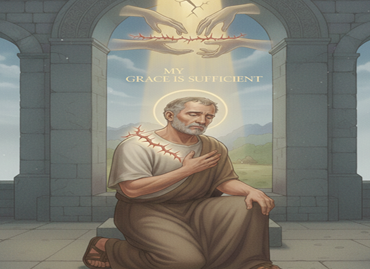
Scripture: 2 Corinthians 12:7–8
“…a thorn was given me in the flesh, a messenger of Satan to harass me… Three times I pleaded with the Lord about this, that it should leave me.” (2 Corinthians 12:7–8)
Medical anthropologists classify human sickness into two categories: ‘Illness’ and ‘Disease.’
‘Illness’ is defined not just by physical symptoms, but by the cultural, social, and religious prejudices and metaphors attached to it. For example, viewing a physical ailment as a “divine punishment” or “discipline” for human disobedience or sin is a classic example of interpreting sickness as ‘illness’ rather than disease. Even today, many people still view human suffering through this lens, inadvertently wounding the sick twice—once through physical pain, and once through stigma.
On the other hand,‘Disease’ refers to the modern, scientific understanding of sickness. It is viewed simply as a physical or mental malfunction, free from prejudice or metaphor. If you’re sick, you go to the hospital; if you need medicine, you go to the pharmacy. It is understood as a purely clinical reality.
However, for the people in Paul’s time, the understanding of human suffering (physical, mental, or psychological) belonged almost entirely to the former—’Illness.’
To us today, this perspective may seem foreign. But back then, sickness was seen as a result of sin or disobedience toward God. Therefore, before seeking medical or scientific treatment, the priority was to appease “divine wrath” through rituals or spiritual means.
With this background in mind, we can begin to understand why Paul pleaded with the Lord so fervently, almost desperately, to remove the “thorn” from his body.
It wasn’t simply because it was painful or inconvenient.
As a messenger of the Gospel, Paul found himself in a contradictory position: he was preaching the grace of God while carrying a physical ailment that society viewed as a divine curse or punishment. It was a crisis of credibility and a source of profound spiritual tension.
At the same time, we can also begin to fathom the depth of the discouragement Paul must have felt when the Lord answered by saying the “thorn” would remain.
Looking into Paul’s experience is like looking into a mirror.
I often find myself under the illusion that the [removal of my weaknesses and flaws] is the only “grace” the Lord should rightfully grant me.
Yet, in that very place, I am met with a seemingly absurd answer: that the [preservation of those weaknesses and flaws] is, in fact, the grace He provides.
Through this, Paul’s experience of being “rejected” becomes my own present reality. While I may not yet reach the level of Paul’s “boasting in my weakness” (2 Cor 12:9), I begin to look at those remaining flaws with a heart of “spiritual acceptance.”
In doing so, I overcome one more hurdle and take one more step forward. Perhaps that is precisely what it means to live by faith.