Through the five senses
we experience
and grasp the world.
Each day
I receive it
into my inside,
and at the same time
each day
I send it
to my outside.
Among these movements
there is the act
of sending outward—
that is,
the work
of forgetting.
At that moment,
I become the subject.
Here,
to forget
is my action,
and
what is forgotten
is the other.
Yet,
on the other hand,
in that very way,
I myself
am received
into someone else’s inside,
and at the same time
sent out
to someone else’s outside.
There,
being forgotten,
I become
the object
of forgetting.
Thus
I am one who forgets,
and at the same time
one who is forgotten.
Forgetting
and
being forgotten—
an endless repetition.
And yet,
in the end
everyone
is forgotten,
at last
in that unavoidable place
called death.
∎ Isaiah 49:14–16a (NIV)
(14) But Zion said, “The LORD has forsaken me,
the Lord has forgotten me.”
(15) “Can a mother forget the baby at her breast
and have no compassion on the child she has borne?
Though she may forget,
I will not forget you!
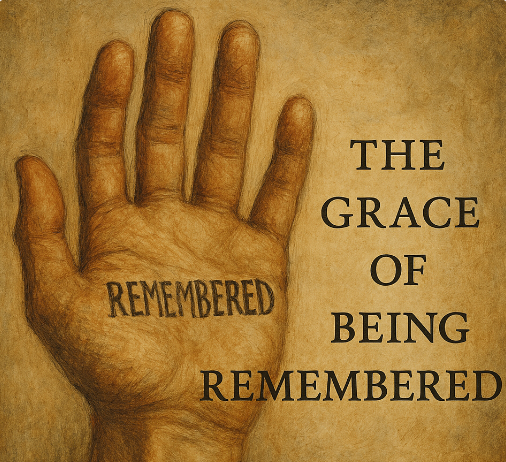
(16) See, I have engraved you
on the palms of my hands.”
And yet,
I—
who am an object
of being forgotten
by others—
may become
an object of grace.
For the One
who made me
always receives me
into His inside,
and never
sends me
to the outside.
I forget some,
and I am forgotten by others.
Thus
we become to one another
both the ones who forget
and the ones forgotten.
But for Him alone,
I
am never forgotten—
only remembered.
The grace
of being remembered.
There,
in that place,
beyond
the threat of being forgotten,
the crisis of being forgotten,
the anxiety of being forgotten,
and the sorrow of being forgotten,
I discover
the stability of existence.
In the memory
of the One
who has engraved me
upon His hands,
today as well
I,
you,
and we
exist.