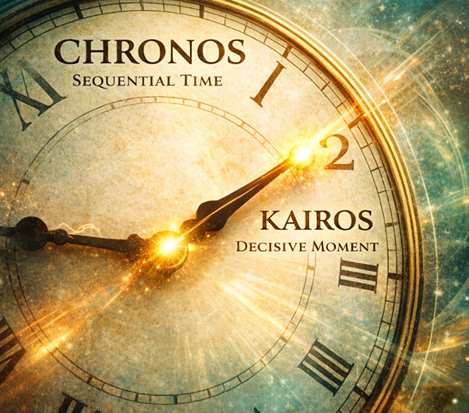
In contemporary Christian discourse, particularly in preaching and popular theology, the distinction between kairos (καιρός) and chronos (χρόνος) is often simplified into a dichotomy: kairos as “God’s time” and chronos as “human time.” However, such a formulation requires critical reconsideration in light of linguistic and biblical evidence.
Both kairos and chronos are common Greek nouns denoting “time,” and neither term is intrinsically defined by a particular subject—divine or human. Rather than indicating two different owners of time, the distinction between the two terms lies in the quality and mode of temporality they express.
Chronos refers to sequential, measurable time—time as duration. It emphasizes the quantitative aspect of temporality, within which events unfold in linear succession. By contrast, kairos denotes an “appointed time,” a “fitting moment,” or a “decisive occasion,” highlighting the qualitative dimension of time in which a significant event occurs or a turning point is realized.
This distinction is also reflected in biblical usage. For example, in Mark 1:15—“The time is fulfilled, and the kingdom of God has come near”—the word translated as “time” is kairos, indicating not merely the passage of time, but a decisive moment in which God’s salvific action is manifested. In this sense, kairos is often associated with the activity of God.
However, such usage does not justify reducing kairos to “God’s time” alone. In Luke 4:13—“When the devil had finished every test, he departed from him until an opportune time”—the expression translated as “an opportune time” is also kairos. Here, the term is clearly related to the activity of Satan, referring to a strategic or decisive moment for renewed temptation. This demonstrates that kairos cannot be confined to a single subject or agent.
Similarly, chronos, while closely associated with human experience, cannot be reduced to a merely human domain independent of divine sovereignty. In Acts 1:7—“It is not for you to know the times or periods that the Father has set by his own authority”—the term translated as “times” (chronos) refers to measurable periods that nevertheless remain under God’s sovereign authority.
Therefore, the common dichotomy that equates kairos with “God’s time” and chronos with “human time” should be regarded as an oversimplification that fails to account for the linguistic and scriptural nuances of these terms. A more accurate understanding recognizes chronos as “sequential or measurable time,” and kairos as “significant or opportune time.”
Such a clarification not only refines our theological understanding of time but also contributes to a more balanced and precise interpretation of biblical texts.