Why would Jesus speak of meekness in this way?
To answer this, we must look at the world of His audience.
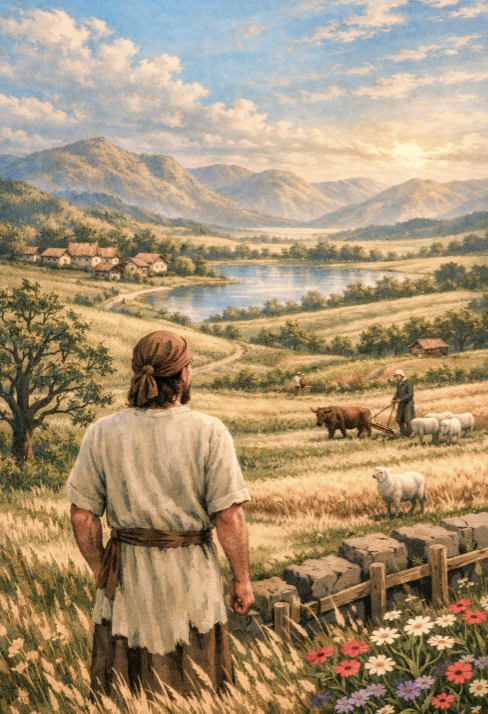
First-century Galilee was not a peaceful place. It was marked by:
◼ Political oppression under the Roman Empire
◼ Economic exploitation and crushing debt
◼ The loss of land and livelihood
Many people were filled with anger and resentment. Their suffering produced a deep longing for justice — and often, a desire for revenge.
In this environment, revolutionary movements began to emerge. Some groups believed that God’s Kingdom should be established through force. They advocated armed resistance, violent uprising, and the elimination of enemies.
To many, this seemed not only justified, but necessary.
It is precisely into this atmosphere that Jesus speaks:
“Blessed are the meek.”
This was a shocking statement.
It challenged the dominant belief that justice must be achieved through power, and that enemies must be defeated through violence.
Instead, Jesus presents an alternative:
The Kingdom of God is not built through force.
It is not established by crushing opponents.
It does not advance through coercion or domination.
Rather, it emerges through a different way —
the way of meekness.
This does not mean passivity or indifference to injustice. It means refusing to become what we oppose.
It means choosing not to replicate violence, even when we have every reason to do so.
Application
Personal Life
In our daily lives, we encounter criticism, misunderstanding, and sometimes unjust accusations.
Our natural instinct is to defend ourselves, to retaliate, to restore our dignity through counterattack.
Yet the way of Christ calls us elsewhere.
On the cross, Jesus did not respond with vengeance. Instead, He prayed:
“Father, forgive them.”
Meekness, in this sense, is deeply unnatural to us. It goes against our instincts. And yet, it is precisely this way that marks those who belong to the Kingdom.
Social Life
As believers, we are called not only to personal transformation, but also to participate in the expansion of God’s Kingdom in the world.
However, history offers a sobering lesson:
Whenever noble ideals are pursued through violent means, they become distorted.
The desire for purity, justice, or truth can lead to exc lusion, oppression, and even destruction when enforced through power.
This is why the method matters.
The Kingdom of God must be pursued in the way of Christ —
not only in its goal, but in its means.
Conclusion
“Blessed are the meek.”
This is not a call to weakness, but to a deeper strength —
the strength to refuse violence,
to endure without hatred,
and to trust in God’s justice.
Such people, Jesus says,
are the ones who will inherit the earth.