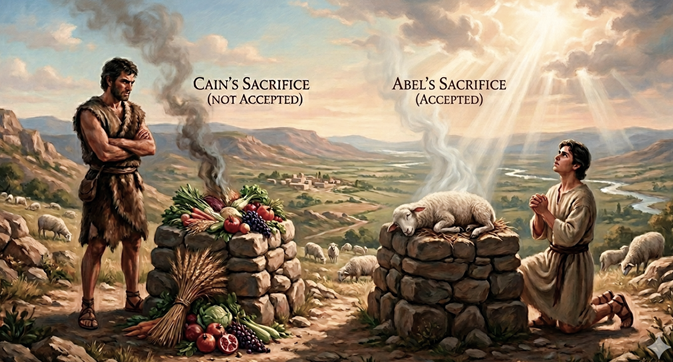
Worship Begins Before the Offering
Life Came Before Worship
In a previous article, we explored an important clue found in Genesis 4.
The biblical text does not merely mention “the offering” itself.
Instead, it records:
“Abel and his offering”
“Cain and his offering”
Furthermore, the Hebrew word used in the passage, שעה (sha‘ah), does not simply mean “to accept.” It also carries the sense of ’to look upon attentively, to regard, to observe, or to pay close attention to.‘
This wording suggests an important possibility: that God first looked at the person himself, and only afterward at his offering.
If so, the question becomes more specific:
What exactly was wrong with Cain?
Interestingly, Scripture provides a clearer clue than we might expect.
That clue appears in God’s own words to Cain.
In Genesis 4:6–7, God speaks to Cain in his anger:
“Why are you angry? Why has your face fallen?
If you do what is right, will you not be accepted?
But if you do not do what is right, sin is crouching at your door.
It desires to have you, but you must rule over it.”
These words are highly significant.
Because what God says to Cain is not directed toward the offering itself.
God does not say:
“You brought the wrong offering.”
Nor does He say:
“You should have brought an animal instead of grain.”
Instead, the focus of God’s words lies somewhere entirely different:
“If you do what is right…”
In other words, the issue appears to concern not the form or category of Cain’s sacrifice, but rather Cain’s life and inner disposition.
What deserves even closer attention is Cain’s behavior afterward.
In Genesis 4:8, Cain ultimately brings his brother Abel into the field and kills him.
Interestingly, several ancient textual traditions—including the Greek Septuagint (LXX), the Samaritan Pentateuch, and the Latin Vulgate—preserve this scene with an additional phrase:
“Let us go out to the field.”
This wording may suggest that Cain’s act was not merely an impulsive explosion of anger, but involved at least some degree of intention and deliberation.
Of course, this does not necessarily mean it was a meticulously planned murder. Yet at the very least, Scripture portrays Cain’s anger as moving in an extremely dangerous direction.
At this point, an important question emerges:
Where did Cain’s anger begin?
Its starting point was God’s rejection of his offering.
Yet Cain does not direct his anger toward God.
Instead, he turns it against his brother Abel.
In a sense, rather than examining himself, Cain responds by transferring the source of the problem onto someone else.
And perhaps it is precisely within that response that Scripture reveals something about Cain’s inner condition.
When we reread Genesis 4:6–7 in this light, God’s words begin to sound quite different:
“If you do what is right, will you not be accepted?”
This is not merely a comforting statement telling Cain to calm down.
Rather, it seems more like a warning that something was already going wrong in the direction of Cain’s life.
If so, the heart of Genesis 4 may not simply be the question of “What kind of offering was brought?”
But rather:
“What kind of person stood before God?”
Seen from this perspective, Hebrews 11:4—where Abel is said to have offered “a better sacrifice by faith”—also takes on a more concrete meaning.
Faith is not merely religious enthusiasm or an emotional state. It is deeply connected to the direction of one’s life, one’s disposition, and the way one stands before God.
At this point, perhaps we should also reflect on our own faith today.
We often devote considerable attention to the outward aspects of worship:
How carefully have we prepared?
How valuable was the offering we gave?
How faithfully have we performed our religious duties?
Of course, this does not mean such things are unimportant.
Yet the question Genesis 4 ultimately asks is something far more fundamental:
Before worship, what kind of life are we living?
If God first looks at the person, worship cannot be completed merely through religious activity.
Worship separated from life, faith disconnected from character, and piety lacking sincerity may ultimately become hollow.
In this sense, the story of Cain and Abel is not merely an ancient tragedy.
It asks the same question of readers today:
What is God looking at first within us?
Perhaps the worship that pleases God is not merely a religious formality,
but something built upon a life shaped by sincerity and right direction long before worship begins.