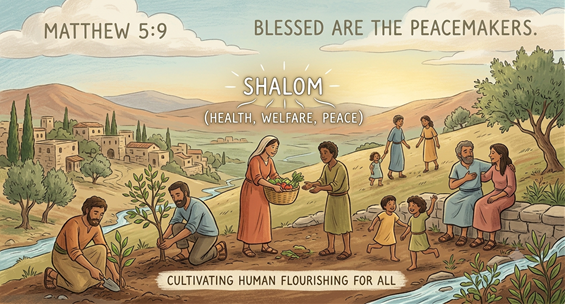
Text – Matthew 5:9
The Honor of Being Called Sons of God
“Blessed are the peacemakers, for they shall be called sons of God.” (Matthew 5:9)
This week’s sermon continues our study of the Beatitudes found in the Sermon on the Mount.
As we have noted in previous messages, the word translated “blessed” is the Greek term makarios (μακάριος), which refers to a person who is truly happy or living in a state of genuine flourishing.
Likewise, the phrase “they shall be called” reflects what scholars often refer to as the divine passive. In active form, the statement may be rendered:
“God will call them sons of God.”
Another feature worth noting is that the conjunction connecting the two clauses is omitted. The implied meaning is:
“Blessed are the peacemakers, because God will call them sons of God.”
To understand this promise properly, we must first examine what the expression “sons of God” meant within the biblical tradition.
The Meaning of “Sons of God” in the Old Testament
The expression “sons of God” (huioi theou) must be understood against the background of the Old Testament.
Throughout the Old Testament, God’s people are normally described as “My people” or “My inheritance.” By contrast, the title “sons of God” is used very sparingly, especially when referring to human beings.
In fact, the expression appears only a handful of times.
In the Book of Job, it is used of heavenly beings or angels (Job 1:6; 2:1; 38:7).
In Hosea 1:10, it appears as an eschatological promise concerning God’s future restoration of His people.
Why is the expression so rare?
The answer lies within a common Semitic idiom. In biblical thought, the phrase “son of” often indicates that a person shares the character, qualities, or status of the one named.
For example, when King Saul addressed David as “my son” (1 Samuel 24:16; 26:17, 21, 25), he was not merely expressing affection. The expression implicitly acknowledged David’s future role as Saul’s successor and participant in the royal household.
Against this backdrop, calling a human being a “son of God” becomes an extraordinarily significant statement. It implies participation in God’s character and, in some sense, a sharing in His status and dignity.
For this reason, the Old Testament uses the title with remarkable restraint.
A Distinctive Conviction of the Early Church
When we move into the New Testament, however, we encounter a dramatic change.
Expressions such as “sons of God” and “children of God” appear frequently throughout early Christian writings.
This development reflects a distinctive conviction of the early church, rooted in Jesus’ own teaching that His followers should address God as “Father.”
Unlike the surrounding religious culture, the first Christians understood themselves as belonging to God’s family in a uniquely intimate way.
Consequently, the promise found in Matthew 5:9 points to something far greater than a simple religious label.
To be called a son of God means to participate in God’s character and purposes. It signifies an elevation of human dignity and status granted by God Himself.
Yet Jesus presents this not as a present possession, but as an eschatological promise. God will ultimately acknowledge such people as His sons.
It is also worth noting that the New Testament overwhelmingly reserves the title “Son of God” for Jesus Christ Himself. More commonly, believers are called “children of God.”
Although the expressions differ, they communicate a closely related idea: a people who belong to God and reflect His character.
An Honor Earned Through Action
At this point we must ask an important question.
How does one receive this honor?
The New Testament repeatedly associates the identity of God’s children with concrete action rather than mere inward reflection.
This becomes especially clear in the Johannine writings, where the language of “children of God” emerges within contexts of persecution, opposition, and conflict.
The earliest Christians did not receive this title because they engaged in private contemplation or cultivated a purely inward spirituality.
Rather, they received it because they openly confessed their faith in Christ despite the cost.
In many cases, public identification with Jesus meant social rejection, economic hardship, or even death.
Yet they continued to live out their faith.
Their identity as God’s children was therefore connected to faithful action and visible commitment.
For this reason, being called a son or child of God is not merely a reward for holding correct beliefs internally. It is a spiritual honor associated with embodying God’s will in the midst of real-life circumstances.
The same principle applies to Matthew 5:9.
The promise is not directed toward those who passively enjoy peace.
Rather, it is directed toward those who actively pursue it, create it, and embody it through concrete action.
The peacemaker is not merely a peaceful person.
The peacemaker is a person who works for peace.
And it is such people whom God promises to call His sons.