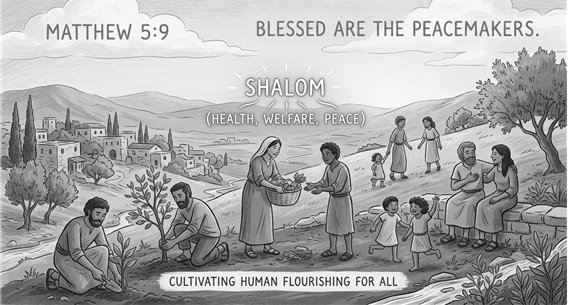
Text – Matthew 5:9
Shalom and the World of Jesus
In Matthew 5:9, Jesus declares:
“Blessed are the peacemakers, for they shall be called sons of God.”
If the promise concerns those who actively pursue peace, we must ask another question:
What exactly is the peace they are called to make?
To answer this, we must look more closely at the biblical idea of peace itself.
The Rich Meaning of Shalom
The Greek word translated “peace” in the New Testament is eirēnē (εἰρήνη).
This word is commonly used to translate the Hebrew term shalom (שָׁלוֹם) in the Old Testament.
Unfortunately, many modern readers reduce peace to the mere absence of conflict.
Biblical shalom is far richer than that.
Throughout the Old Testament, shalom appears in a wide variety of contexts.
It can refer to physical well-being, prosperity, successful endeavors, harmonious relationships, social stability, peaceful relations among nations, and reconciliation with God.
Taken together, these dimensions may be summarized under three broad categories:
Health.
Welfare.
Peace.
Health refers not only to bodily well-being but also to emotional, psychological, and spiritual wholeness.
Welfare concerns the material conditions that sustain human life, including economic security and social stability.
Peace, in turn, is the quality of life that emerges when health and welfare flourish together.
In other words, shalom describes a condition in which human beings are able to thrive as God intended.
Therefore, when Jesus speaks of peacemakers, He is not referring merely to people who avoid arguments.
He is speaking of those who actively seek and cultivate the conditions under which genuine human flourishing becomes possible.
The peacemaker does not merely enjoy shalom.
The peacemaker works to create it.
The Hidden Assumption Behind Jesus’ Words
Jesus’ statement contains an important implication.
Whenever someone says,
“Blessed are the peacemakers,”
there is an unspoken assumption that peace is somehow absent, distorted, threatened, or monopolized.
Just as the command to love one another presupposes situations in which people fail to love one another, so the call to make peace presupposes a world where peace is lacking.
This means that Jesus’ audience would naturally have recognized several kinds of people standing in opposition to God’s vision of shalom.
Some sought to restrict the benefits of peace to a privileged few.
Others wished merely to enjoy peace without contributing to it.
Still others secured their own well-being at the expense of others.
Who were these people?
Who would Jesus’ listeners have imagined when they first heard these words?
Peace Under Empire
Within the historical setting of Jesus’ ministry, two groups stand out.
The first was the Roman Empire.
The second was the local aristocratic class that benefited from and collaborated with Roman rule.
The Romans famously spoke of the Pax Romana—the Peace of Rome.
Yet this peace came at a tremendous cost.
The prosperity and stability enjoyed by Rome were often built upon the labor, taxation, and exploitation of conquered peoples.
Land was confiscated.
Heavy taxes were imposed.
Labor was extracted.
Military service was demanded.
The empire’s peace depended upon structures that frequently deprived others of their own well-being.
At the same time, sections of the Jewish aristocracy, particularly those associated with the priestly elite, cooperated with Rome and shared in the benefits of the imperial system.
Together, these groups enjoyed the fruits of peace while restricting its blessings to those within their own circles of privilege and power.
Their version of peace was not universal.
It was selective.
It was exclusive.
And it was sustained through systems that often prevented others from experiencing the same blessings.
Another False Response
Yet there was another group as well.
On the opposite side stood revolutionary movements such as the Zealots.
Unlike Rome and its collaborators, these groups sought to recover what had been lost through active resistance and, at times, violent struggle.
Their goal was understandable.
They longed to reclaim the welfare, dignity, and freedom that had been taken from their people.
Yet Jesus did not simply endorse their methods.
As we observed in the previous Beatitude concerning the meek, Jesus consistently pointed toward a different path.
He rejected both imperial domination and violent retaliation.
Neither represented God’s kingdom.
Neither reflected God’s shalom.
When Jesus spoke of peacemaking, He was inviting His followers into an alternative vision of human flourishing—one that neither exploited others nor sought redemption through violence.
The Radical Vision of Jesus
This helps us appreciate how provocative Jesus’ words truly were.
To proclaim:
“Blessed are the peacemakers”
was not a sentimental statement about getting along with others.
It was a challenge to every distorted version of peace that existed in His world.
It challenged those who accumulated peace for themselves while denying it to others.
It challenged those who built prosperity upon exploitation.
It challenged those who believed violence could create lasting wholeness.
Jesus was announcing a radically different kingdom.
A kingdom in which peace is not hoarded.
A kingdom in which peace is not imposed.
A kingdom in which peace is shared.
The peacemaker, therefore, is not simply a peaceful individual.
The peacemaker is someone who participates in God’s work of restoring shalom to the world.
And it is such people whom Jesus calls blessed.