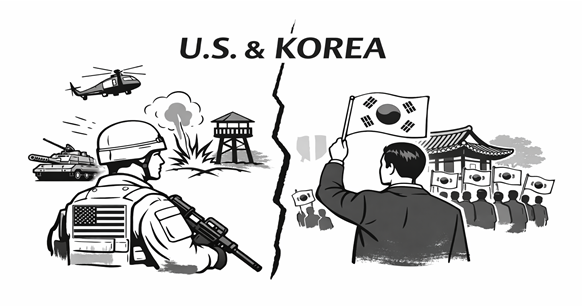
There is an old saying about war: “You may win battles and still lose the war.” Conversely, “You may lose battles and still win the war.” This is more than a military proverb—it reflects a deeper truth about international politics. Military superiority and political victory are not the same thing.
Over the past decades, the United States has maintained its position as the world’s strongest power through overwhelming military and technological superiority. Yet, when one looks at America’s military engagements across Asia and the broader Eastern sphere—including the Middle East—a troubling pattern appears to emerge: America often wins battles, but struggles to achieve clear victories in war itself.
The beginning of this pattern can arguably be traced to the Korean War. The United States undeniably achieved military success in preventing the collapse of South Korea and halting North Korea’s invasion. Yet the broader objective of reunification failed, and the Korean Peninsula remains divided to this day. In Vietnam, America maintained overwhelming superiority in countless battles, only to withdraw while Vietnam was ultimately unified under the North. In Afghanistan, after twenty years of war, the United States departed and the Taliban returned to power. In Iraq, regime change was achieved, but the stable order America envisioned never fully materialized.
And now, one cannot help but wonder whether a similar pattern is unfolding again in the confrontation with Iran.
A recurring framework seems visible:
Overwhelming force → underestimation of a society’s history and nationalism → short-term military superiority → failure of stabilization or prolonged strategic exhaustion
America often succeeds in defeating military opponents, yet appears less successful in fully understanding the historical memory, national pride, and collective identity that shape those societies. Particularly in Asia, nations exist within a historical framework fundamentally different from that of modern European nation-states. Deep civilizational memory, long historical continuity, experiences of foreign intervention, and strong national consciousness often function as powerful political forces.
Iran offers an important example. In the past, the United States intervened when Iran’s democratic leadership did not align with American interests, supporting the restoration and strengthening of monarchical rule. Yet such actions arguably intensified nationalist resentment within Iran, ultimately contributing to the Islamic Revolution and transforming Iran into one of the most deeply anti-American states in the modern world. Military superiority does not guarantee political loyalty. In many cases, external pressure strengthens internal solidarity and resistance.
In some ways, America seems to underestimate Asia. It often appears to approach Asian societies as geopolitical variables to be managed, or as actors expected to eventually conform to an externally designed order. Yet history suggests Asia has rarely moved in such predictable ways. Across centuries, societies that once appeared to submit to overwhelming force often re-emerged through nationalism, historical memory, and a determination to reclaim dignity.
South Korea is no exception. Since the Korean War, Korea has remained a loyal ally to the United States, honoring the bond forged in blood. Yet alliances cannot be sustained indefinitely through a framework of protector and dependent. One cannot treat an adult child like a kindergarten student and still expect trust. Korea today is no longer merely a nation to be protected. It has become a technologically advanced democracy with growing global influence and strategic importance.
In international politics, there is no such thing as perfect trust or permanent friendship. States ultimately move according to interests. The United States does not maintain its alliance with Korea solely out of goodwill, just as Korea itself has strategic reasons for maintaining the alliance. But that reality makes mutual respect all the more important. Alliances grounded in interests require greater—not lesser—respect for each other’s history, dignity, and political maturity.
Today, many speak of cracks appearing in the foundations of Pax Americana. America remains immensely powerful, without question. Yet perhaps the age in which power alone could sustain global order is beginning to fade. If the United States continues repeating the same strategic patterns, it may once again find itself winning battles while failing to secure lasting political victories.
True stability cannot arise from force alone. It emerges through historical reflection, understanding of others, and mutual respect. To learn from history is not simply to remember the past—it is to recognize repeating patterns and have the wisdom to change them.