Part 3 – Who Were These “Little Ones”?
By now, two important conclusions have emerged.
First, the event took place at Bethel, a city that was far more than an ordinary settlement. It had a long religious history and had become one of the principal political and religious centers of the Northern Kingdom.
Second, the people who confronted Elisha are described with Hebrew words that do not necessarily mean small children. The terms qāṭān and naʿar can refer to people considerably older than the image suggested by the traditional translation “little children.”
But this leaves us with the most important question:
If they were not small children, then who were they?
The answer may lie in bringing the linguistic evidence together with the geographical and political character of Bethel.
Bethel Was a Strategic Stronghold
Bethel’s importance was not merely religious.
Its geographical position gave it strategic significance as well.
The city stood in the central highlands, near the southern part of the Northern Kingdom and relatively close to the territory of Judah. It occupied an important position in the region that had once belonged to Benjamin and lay near the boundary between the territories associated with the northern and southern parts of Israel.
This geographical position mattered especially after the kingdom divided.
Jeroboam did not establish his sanctuary at Bethel simply because it happened to be a convenient location. Bethel had already possessed considerable historical and religious importance, and its position made it particularly valuable to the emerging Northern Kingdom.
Bethel’s importance was not merely religious. Its geographical position also gave it considerable strategic value. Situated near the southern part of the Northern Kingdom, Bethel occupied an important position in the political and military landscape of the divided kingdom. It was therefore not only a religious and political center but also a strategically important stronghold of the Northern Kingdom.
This changes the picture considerably.
Bethel was not simply a town in which ordinary families happened to live.
It was a city that represented the political and religious interests of the Northern Kingdom.
And a strategically important city would naturally require people capable of protecting it.
This brings us back to the Hebrew word naʿar.
Naʿar and the World of Soldiers
As we saw in Part 2, naʿar has an extraordinarily broad semantic range.
It can refer to a child or youth, but it can also designate servants, attendants, officials, young men, and people serving in military contexts. The original examination of the Hebrew Bible found examples ranging from children and youths to mature adults.
But there is an especially important feature of its usage in the historical books of the Old Testament.
The word appears very frequently in narratives concerned with kings, armies, battles, royal households, and political affairs.
A large concentration of adult uses of naʿar appears in Samuel, Kings, and Chronicles. Among these occurrences, many refer not merely to adult men but specifically to men serving in military or combat-related roles.
This is significant.
It means that when we encounter naʿar in a historical narrative, we should not automatically imagine a child.
The surrounding circumstances must determine the meaning.
And the surrounding circumstances of 2 Kings 2 are striking.
The naʿarîm are not described as children playing inside a house.
They come out from the city.
And they confront Elisha as a group.
A Group Emerging from the City
The wording of the passage deserves careful attention.
Elisha is going up toward Bethel when the group comes out from the city and begins to confront him.
This is not presented as an encounter with one or two children who happen to meet a strange-looking man on the road.
The narrative presents a substantial group.
They repeatedly shout:
“Go up, thou bald head; go up, thou bald head.”
The repetition is striking.
Whatever precisely the words mean, the encounter is clearly hostile.
And the timing is equally important.
Elisha has just become the successor of Elijah.
Elijah had been taken up from the earth in a dramatic divine act, and Elisha had returned to the northern territory carrying his master’s prophetic authority.
He then arrives at Bethel.
That is exactly where a confrontation takes place.
If the group consisted of young men associated with Bethel’s political or military establishment, their response suddenly becomes much easier to understand.
They would not simply be making fun of a bald man.
They would be confronting Elisha as the prophet who had inherited Elijah’s authority.
And Elijah was hardly a neutral figure in the religious and political conflict of the Northern Kingdom.
More Than an Insult About Hair
This is where the traditional interpretation may be misleading.
If we imagine ten-year-old children shouting at a bald prophet, the words “Go up, thou bald head” sound like nothing more than childish mockery.
But if the speakers were young men associated with the political or military world of Bethel, the same words could represent something much more serious.
They may have been rejecting Elisha’s presence.
They may have been challenging his authority.
And the command to “go up” may have carried an additional significance immediately after Elijah’s dramatic ascent.
We should therefore be cautious about reducing the entire encounter to an insult concerning Elisha’s appearance.
The issue may have been much larger than his hair.
It may have concerned who had the authority to speak for Yahweh in Bethel.
Were They Soldiers?
At this point, the evidence can be brought together.
The Hebrew vocabulary does not require the group to have been children.
The word naʿar is repeatedly used for adult men and, in the historical books, for men serving in military and official capacities.
Bethel itself was a politically and religiously significant city with strategic importance.
The group came out of the city, rather than simply appearing as a few children playing along the road.
And the group confronted Elisha openly and repeatedly.
None of these details, taken by itself, proves that the people were soldiers.
But taken together, they create a remarkably coherent picture.
The people who confronted Elisha were very likely adult young men associated with the defense, security, or political establishment of Bethel.
In other words, the traditional “little children” may actually have been young men serving in a military or security capacity.
This is not a conclusion derived from a single Hebrew word.
It emerges from the convergence of several lines of evidence:
language, geography, political history, and narrative behavior.
That convergence is what makes the interpretation compelling.
A Different Scene Emerges
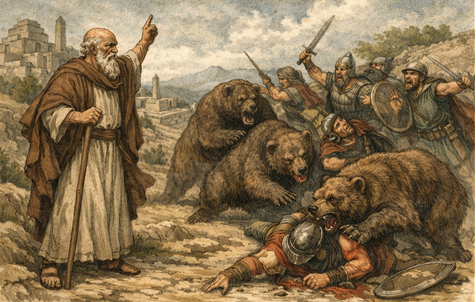
If this reconstruction is correct, then the scene described in 2 Kings 2:23–25 looks very different from the picture most modern readers have inherited.
It was not:
an angry prophet versus a group of mischievous children.
It may instead have been:
a prophet of Yahweh versus a hostile group of young men associated with the strategic stronghold of Bethel.
That is a completely different kind of encounter.
Elisha was not necessarily reacting to a childish insult directed at his appearance.
He may have been confronted by representatives of the very political and religious system that Elijah—and now Elisha—stood against.
The story therefore begins to move away from the question,
“Why was Elisha so angry about being called bald?”
and toward a much more significant question:
“Why was Elisha confronted when he arrived at Bethel?”
That is the question that allows us to understand the final piece of the story.
Conclusion
The traditional image of the episode depends heavily on one assumption:
that the people who confronted Elisha were innocent children.
But the Hebrew vocabulary does not require that conclusion.
Qāṭān can describe people who are relatively young or lesser in status without implying childhood, while naʿar can refer to adult men and people serving in military or official roles.
Bethel, meanwhile, was not merely a village. It was a major religious and political center of the Northern Kingdom and occupied a strategically important location.
When these facts are brought together, the possibility becomes difficult to ignore:
the people who confronted Elisha were very likely young men associated with the defense or security of Bethel—possibly soldiers.
The text does not explicitly identify them as soldiers, and therefore we should not pretend that we possess a certainty the text itself does not provide.
But neither should we allow the traditional translation to impose upon the text an image of small, innocent children that the Hebrew vocabulary itself does not require.
The question, then, is no longer simply why Elisha cursed “children.”
The real question is:
What actually happened when the prophet of Yahweh confronted the stronghold of Bethel?
That is where the final part of the story begins.