The Person Who Lives in Relationship with God
Today’s passage, Psalm 1, is probably one of the most beloved and most frequently quoted psalms among Christians, together with Psalm 23.
Through this psalm today, I hope we may receive encouragement, warning, comfort, and wisdom for the life of faith.
For this sermon, I would especially like to focus on verses 1, 2, and 6.
What Does “Blessed” Mean?
Psalm 1 begins like this:
“Blessed is the one who does not walk in step with the wicked…”
Immediately, the psalmist begins discussing the meaning of blessing itself.
What does it mean to be “blessed”?
What kind of person is truly blessed?
In the Old Testament, there are two major Hebrew words commonly associated with blessing.
One is:
barakh
and the other is:
ashre.
The word barakh is the more common term.
It is often used when:
◾God blesses someone,
◾a divinely authorized representative pronounces blessing,
◾or people pray for blessing upon others.
This kind of blessing flows primarily from God’s grace, mercy, and generosity regardless of human merit.
But the word used in Psalm 1 is not barakh.
It is ashre.
And this difference matters enormously.
Because ashre usually refers to the blessedness experienced by someone living in faithful relationship with God —
someone walking in obedience and communion with Him.
In other words:
The psalmist has already defined what kind of blessing he is talking about.
The “blessed person” in Psalm 1 is not primarily someone possessing wealth, success, comfort, or prosperity.
Rather:
The truly blessed person is the one living in relationship with God.
And later, in verse 6, the psalmist calls such a person:
“the righteous.”
Who Are the Wicked?
And once we understand this,
another conclusion immediately follows.
Who, then, are “the wicked”?
Most people instinctively think of wicked people merely as morally evil individuals.
But within the logic of Psalm 1,
the wicked are fundamentally those who live outside relationship with God —
people who neither seek nor feel any need for Him.
And the same applies to the biblical concept of sin itself.
In Scripture,
sin is not merely moral imperfection.
Consistently throughout both the Old Testament and the New Testament,
sin fundamentally refers to:
a condition of separation from God,
and a life remaining within that separation.
This perfectly fits the structure of Psalm 1.
The Gradual Descent
Now look carefully at verse 1.
The description unfolds through three escalating stages:
“walk…”
“stand…”
“sit…”
This is a gradual progression.
A descent.
And if we remove the negative wording for a moment, the structure becomes clearer:
1. walking according to the counsel of the wicked,
2. standing in the way of sinners,
3. sitting in the seat of mockers.
The movement intensifies step by step.
The Counsel of the Wicked — The Ear
First:
“walking according to the counsel of the wicked.”
The Hebrew text literally describes someone walking according to the advice,
plans,
wisdom,
or counsel
of those who live apart from God.
In other words,
it describes allowing such voices to become the decisive framework for choosing one’s path in life.
And therefore the righteous person is someone who does not ultimately determine life according to those voices.
This stage relates to the ear.
To what we repeatedly listen.
To what captures our attention.
To which voices we gradually give authority.
The Way of Sinners — The Eye
Second:
“standing in the way of sinners.”
Now the situation deepens.
This is no longer merely listening.
It is participation.
Companionship.
Shared direction.
To walk the same road with someone means:
sharing the same destination,
the same life-goal,
the same understanding of success.
And therefore the righteous person refuses to define life according to the same ultimate goals pursued by those living apart from God.
This stage relates to the eye.
To what we desire.
To what we admire.
To what kind of life quietly fascinates us.
The Seat of Mockers — The Body
Third:
“sitting in the seat of mockers.”
The Hebrew word translated “seat” here does not merely mean a chair or sitting place.
It refers more broadly to a dwelling place,
an inhabited community,
a settled social environment.
In other words,
this final stage describes sharing an entire way of life.
A common lifestyle.
A common rhythm of existence.
At this point,
the person has moved beyond merely listening to certain voices
or admiring certain goals.
Now the body itself participates.
One begins to enjoy,
practice,
and embody
the same patterns of life.
Thus the progression moves through:
◾the ear,
◾the eye,
◾and finally the body itself.
Listening.
Admiring.
Then embodying.
And therefore the righteous person is someone who refuses to fully inhabit the same lifestyle as those living apart from God.
Why Does the Righteous Person Live Differently?
And this leads to the obvious question:
Why?
Why does the righteous person refuse this path?
Verse 2 answers:
“Because…”
Most modern translations unfortunately omit an important conjunction at the beginning of verse 2.
But the Hebrew includes the word:
ki — “because.”
And once we restore it, the logic becomes much clearer:
Blessed is the one who does not walk according to the counsel of the wicked,
nor stand in the way of sinners,
nor sit in the seat of mockers —
because
he delights in the law of the Lord
and meditates on it day and night.
The righteous person lives differently because the Word of God functions as the decisive reference point for life.
The Word shapes:
◾what he listens to,
◾what he looks toward,
◾ and how he ultimately lives.
The Word as Treasure
And something else in verse 2 is especially beautiful.
The word translated “delight” comes from the Hebrew noun:
hephets.
This word can mean:
◾joy,
◾pleasure,
◾precious treasure,
◾costly jewel.
Therefore the meaning goes even deeper than simple enjoyment.
The righteous person regards the Word of God like a priceless treasure.
Like a jewel.
And because the Word becomes precious, the apparently attractive lifestyle of the wicked loses its power.
The righteous person no longer envies those paths in the same way.
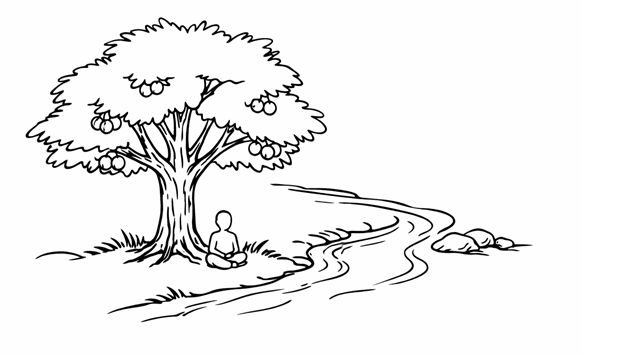
The Tree by Streams of Water
Verse 3 then describes the reality and future of the righteous person:
“He is like a tree planted by streams of water…”
In the ancient Near East,
where drought and desert landscapes were common,
a tree planted beside water symbolized the highest imaginable condition of life and stability.
Its leaves do not wither.
It bears fruit in season.
It survives.
It flourishes.
This is the image the psalmist uses for the one rooted in God’s Word.
The Chaff
But verses 4 and 5 present the opposite image.
The wicked are compared not to a deeply rooted tree, but to chaff blown away by the wind.
Weightless.
Unstable.
Without lasting substance.
The contrast is intentional.
One life possesses rootedness and endurance.
The other dissolves under pressure.
The Lord Knows
Verse 6 explains why this difference exists:
“For the Lord knows the way of the righteous, but the way of the wicked will perish.”
Again,
the verse begins with:
“because.”
The Lord “knows” the way of the righteous.
The Hebrew word is:
yada.
It means:
to know,
observe,
recognize,
perceive,
pay attention to,
be deeply acquainted with.
In other words,
God sees the path of the righteous.
He watches their choices,
their struggles,
their direction,
their obedience,
their life.
And because God knows their way,
their lives ultimately become like trees planted beside streams of water.
This becomes a tremendous comfort for believers living in discouraging realities.
Because often reality appears to contradict Psalm 1.
The Hidden Background Behind Psalm 1
And this leads to a very important question.
Why did the psalmist speak this way in the first place?
What kind of reality stood behind this psalm?
Every strong declaration in Scripture usually emerges against an opposing reality.
For example,
the New Testament repeatedly commands believers to “love one another.”
Why?
Not because the churches were overflowing with harmony.
But because conflict,
division,
competition,
and hostility already existed inside the community.
Likewise,
Psalm 1 exists because there were people who looked at the world and concluded:
“Living according to God’s Word is not worth it.”
People saw the success,
prosperity,
comfort,
and visible happiness
of those living apart from God.
And many believers became shaken.
Discouraged.
Confused.
Tempted.
This is why the psalmist speaks so forcefully.
In many ways,
Psalm 1 functions almost like spiritual propaganda directed toward struggling believers.
The psalmist knows the temptation.
He knows how attractive unbelief can appear.
He knows how persuasive the voices of mockers can sound.
In fact,
the word translated “mockers” comes from a Hebrew root meaning:
to scoff,
ridicule,
or mock.
These are people who ridicule trust in God itself.
And Scripture elsewhere gives us examples of such attitudes.
In Malachi 3,
people complain:
“What is the point of serving God?
The arrogant seem blessed.
Evil people prosper.”
That is the world standing behind Psalm 1.
The psalmist sees:
◾wicked people succeeding,
◾unbelief appearing practical,
◾compromise appearing profitable,
◾obedience appearing foolish.
And standing between those two worlds
are struggling believers —
people torn between faith and unbelief,
between trust and cynicism,
between obedience and compromise.
These are the true audience of Psalm 1.
The psalmist is speaking not primarily to the wicked,
but to believers tempted to envy them.
And to such people he declares:
True blessedness is not found in visible success apart from God.
True blessedness is found in relationship with Him.
Where Are Your Ears, Eyes, and Body Directed?
And therefore the final question becomes deeply personal.
Where are your ears directed?
What voices are shaping your decisions?
Where are your eyes directed?
What kind of life secretly fascinates you?
Where is your body directed?
What patterns of life are you gradually embodying?
Psalm 1 calls us back to the Word of God —
not merely as religious information,
but as the decisive orientation of existence itself.
Therefore may all of us treasure the Word of God like a priceless jewel.
May we receive from it the wisdom by which we choose our path.
And may our lives become like trees planted beside streams of water —
deeply rooted,
fruitful,
and enduring.
I pray this in the name of Jesus Christ our Lord.