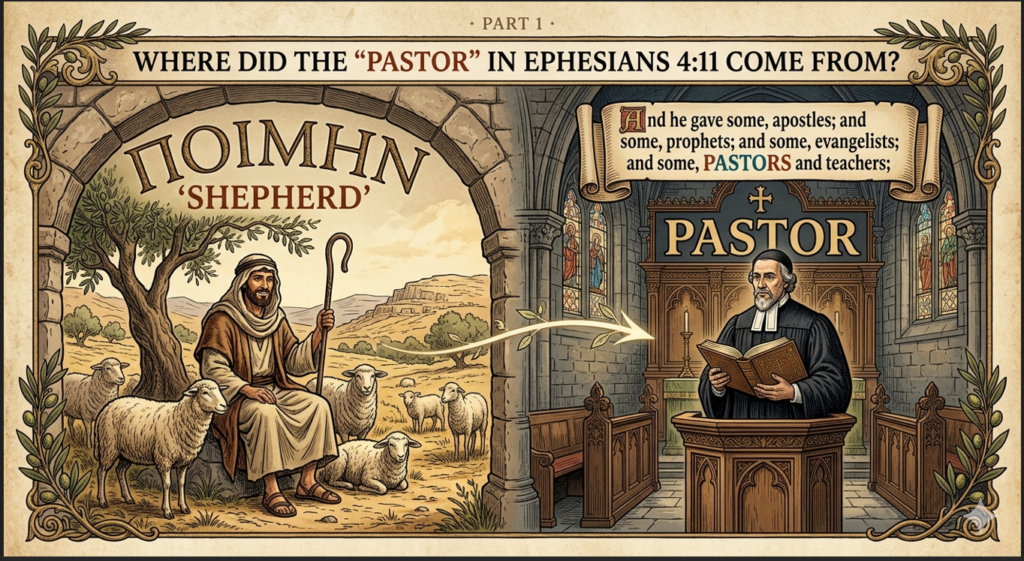
— A Textual and Translational Inquiry
1. Introduction: Raising the Question
Ephesians 4 emphasizes the unity and maturity of the Christian community, describing how God has appointed various roles for the building up of the church. Among these, verse 11 is of particular importance:
“And he gave some, apostles; and some, prophets; and some, evangelists; and some, pastors and teachers;” (KJV)
This verse is commonly cited as a biblical foundation for the office of the “pastor.” However, a critical question must be raised:
Did the office of “pastor,” in the modern Protestant sense, actually exist in the first-century context of the New Testament?
This question is not merely terminological. It invites a deeper inquiry into the relationship between translation, interpretation, and the formation of church structures.
2. The Greek Text and Its Meaning
The Greek text of Ephesians 4:11 reads:
καὶ αὐτὸς ἔδωκεν τοὺς μὲν ἀποστόλους,
τοὺς δὲ προφήτας,
τοὺς δὲ εὐαγγελιστάς,
τοὺς δὲ ποιμένας καὶ διδασκάλους
The term of interest here is ποιμένας (poimenas), derived from the root ποιμήν (poimēn).
The lexical meaning of poimēn is straightforward:
◼ “shepherd”
◼ one who tends, cares for, and protects a flock
In the New Testament, this term appears approximately eighteen times and is consistently translated as “shepherd” in most contexts, such as:
◼“sheep without a shepherd”
◼“the good shepherd”
◼ “the shepherd of the sheep”
Thus, the semantic field of poimēn is stable and well established.
3. A Translational Discontinuity
A striking observation emerges when examining the translation of this term across different passages.
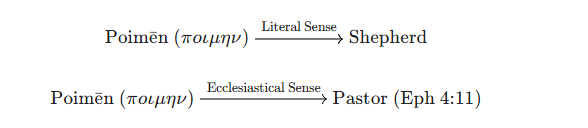
While poimēn is rendered as “shepherd” in the overwhelming majority of its occurrences, it is translated as “pastor” specifically in Ephesians 4:11 in many modern translations.
This raises an important issue:
◼ The same Greek word
◼ The same semantic range
◼ Yet a different translation in a specific context
Such a shift suggests more than a simple variation in wording. It points toward a contextually driven interpretive decision, possibly influenced by later ecclesiastical developments.
In particular, because Ephesians 4:11 lists roles within the church, the translation “pastor” may reflect not only linguistic judgment but also institutional interpretation.
4. Interim Conclusion
From the observations above, a critical question emerges:
Why is the same term translated differently only in this specific passage?
To adequately address this issue, one must move beyond lexical analysis and consider broader factors, including:
◼ the Latin translation tradition
◼ the historical development of church offices
These aspects will be explored in the following essay.
👉 To be continued in Part 2.