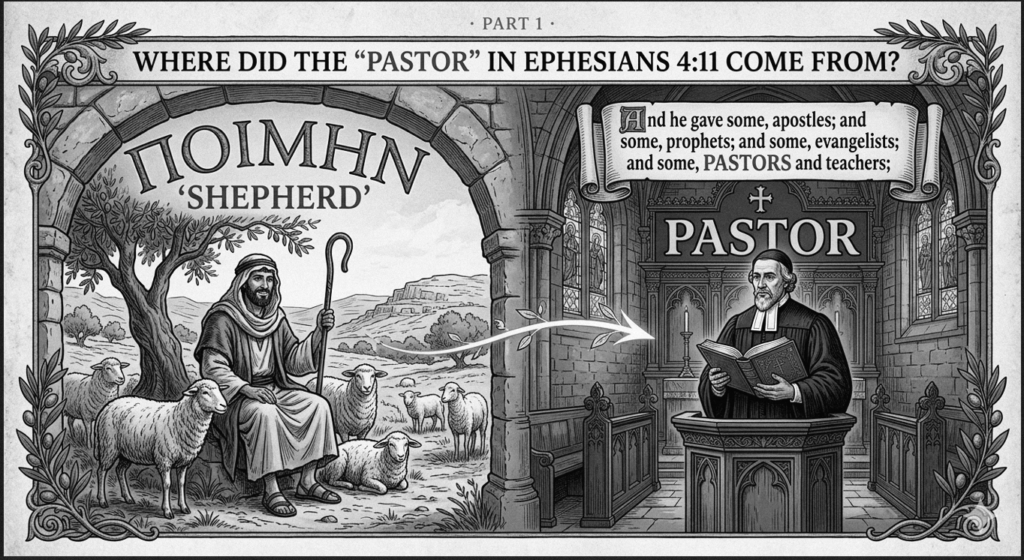
— Translation, History, and the Formation of Church Office
1. From Greek to Latin: The Word Pastor
The Greek term ποιμήν was translated into Latin as pastor in the Vulgate.
In classical and ecclesiastical Latin, pastor simply means:
◼ “shepherd”
◼ “one who tends a flock”
However, as the term moved into later linguistic and ecclesial contexts, its meaning underwent a significant transformation.
In modern English usage, “pastor” no longer primarily denotes a literal shepherd but rather:
◼ a church leader
◼ a clergyman in Protestant traditions
Thus, the semantic development can be summarized as follows:
◼ Greek (poimēn): shepherd
◼ Latin (pastor): shepherd
◼ English (pastor): church leader
In this process, a metaphorical image became an institutional title.
2. The Reformation and the Solidification of Meaning
The Protestant Reformation of the 16th century played a decisive role in shaping the modern understanding of church offices.
As new ecclesiastical structures emerged, the term “pastor” became a central designation for spiritual leadership within Protestant communities.
Within this historical framework, Ephesians 4:11 came to be read as a direct biblical endorsement of the pastoral office.
However, this reading must be approached with caution.
It is more accurate to say that:
◼ the text was reinterpreted through the lens of later church structures,
rather than
◼ the text itself originally prescribing a formal office identical to the modern “pastor.”
3. Hermeneutical Implications
This discussion leads to a broader and more significant insight:
Translation is never entirely neutral.
Biblical translation is always shaped by:
◼ theological assumptions
◼ historical context
◼ ecclesial traditions
In some cases, translation choices may even reflect an attempt—conscious or unconscious—to align the text with established institutional realities.
Therefore, the term “pastor” should not be understood as a direct and original designation found in the New Testament text, but rather as:
a historically developed expression of the shepherding function described in the text.
4. Conclusion
Ephesians 4:11 presents a set of roles intended to build up the Christian community. However, interpreting this passage as a direct reference to the modern pastoral office requires careful reconsideration.
A more textually grounded understanding would recognize that:
the passage speaks of a shepherding function,
not necessarily a formally defined ecclesiastical office.
The modern concept of the “pastor” can thus be seen as:
◼ a legitimate historical development,
◼ but not a direct lexical equivalent of the original Greek term.