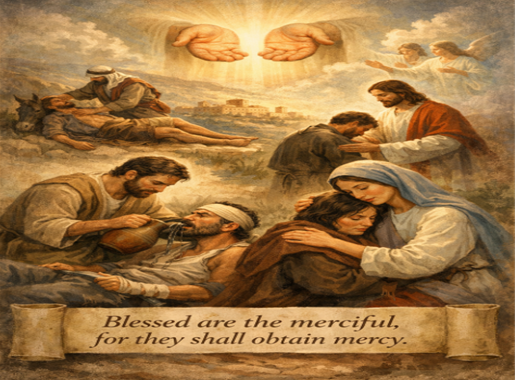
Text – Matthew 5:7
Humanity Cannot Stand Without the Mercy of God
Matthew 5:7 declares:
“Blessed are the merciful, for they shall receive mercy.”
This verse belongs within the broader context of the Sermon on the Mount and, more specifically, within the section commonly called the Beatitudes. The Sermon on the Mount contains the ethical teachings Jesus gave to His disciples — not merely private spiritual instructions, but guidance for social and relational life within the kingdom of God.
The word translated as “blessed” comes from the Greek word makarios. More than simply describing a “fortunate person,” it refers to one who lives in a state of true happiness and flourishing. It describes a reality shaped by God Himself.
The expression “the merciful” comes from the Greek word eleēmones, a term often translated as “merciful” or “compassionate.” Yet behind this Greek expression stands a much deeper Old Testament background. In the Greek translation of the Old Testament, this word was frequently used to translate the Hebrew word raḥam.
The remarkable thing about raḥam is that its root refers to a mother’s womb.
In the Old Testament, this imagery became one of the most profound ways of describing the compassion of God. Just as a mother carries and protects a child within her womb, God embraces, sustains, and patiently bears His people. His mercy is not cold tolerance, but intimate, life-giving compassion.
This concept is often paired with another important Old Testament word: hesed, the covenantal love of God. Together, these two expressions portray the fullness of divine love — both the faithful love of a father and the nurturing compassion of a mother.
Particularly in contexts of forgiveness and restoration, these two themes appear side by side.
Thus, the mercy described in Matthew 5:7 is not simply emotional softness. It includes forgiveness, acceptance, patience, endurance, and the willingness to continue embracing others despite their weakness and failure.
What is especially significant in this Beatitude is its grammatical structure.
The latter half of the verse says:
“for they shall receive mercy.”
In the Greek text, the verb is written in the passive voice, yet the subject performing the action is unstated. In New Testament studies, this is often called the “divine passive.” The implied actor is God Himself.
In other words, the meaning is not:
“Merciful people will somehow earn mercy from others.”
Rather, the meaning is:
“God Himself will show mercy to the merciful.”
This same structure appears throughout the Beatitudes:
◾ Those who mourn will be comforted by God.
◾ The meek will receive inheritance from God.
◾ Those who hunger and thirst for righteousness will be filled by God.
◾ The pure in heart will see God.
◾ The peacemakers will be called sons of God.
Likewise, the merciful receive mercy from God Himself.
Yet Matthew 5:7 possesses a unique circular character among the Beatitudes.
The mercy that believers extend to others is not something produced merely from human strength or moral superiority. Rather, Christians show mercy because they themselves have already received mercy from God. We forgive because we have been forgiven. We endure because God continues to endure us. We patiently wait for others because God patiently waits for us.
Therefore, mercy is not simply an ethical action. It is the reflection of God’s own character within human life.
At the deepest level, every human being — especially every Christian — exists as one who constantly depends upon the mercy of God.
Our relationship with God is not sustained because of our achievements, moral perfection, or spiritual success. It continues only because God continues to forgive, embrace, accept, and patiently endure us.
Without the mercy of God, no one can stand before Him even for a single moment.
That is the foundation of the Beatitude:
“Blessed are the merciful, for they shall receive mercy.”