Text – Matthew 5:6, 5:10–12
The Hunger That Must Come Before Bread
Jesus declares in Matthew 5:6:
“Blessed are those who hunger and thirst for righteousness,
for they shall be filled.”
And later, within the same Beatitudes, He says:
“Blessed are those who are persecuted for righteousness’ sake,
for theirs is the kingdom of heaven.”
At first glance, these two declarations may appear separate.
But they are deeply connected.
Because the righteousness Jesus speaks about is not abstract religious theory.
It is a way of life.
And that life inevitably produces conflict.
What Does “Righteousness” Mean?
Before anything else, we must ask the central question:
What does Jesus mean by “righteousness”?
The Greek word is dikaiosynē.
And this word has often been misunderstood.
Some immediately connect it with Paul’s doctrine of justification by faith.
Others reduce it to social justice alone.
But in Matthew’s Gospel, righteousness carries a much broader and more concrete meaning.
It refers to:
living according to the will of God.
More specifically:
living according to the will of God as revealed through Jesus Himself —
through His interpretation,
His teaching,
His explanation,
and His practice.
This is crucial.
Because Jesus repeatedly overturns the accepted religious framework of His time.
Especially in the six famous antitheses later in Matthew 5:
“You have heard it said…
but I say to you…”
There Jesus radically reinterprets the Law.
Murder is no longer merely physical killing;
anger itself becomes a form of murder.
Adultery is no longer merely bodily action;
lust itself becomes adultery.
Retaliation is rejected.
Enemy-love is commanded.
Divorce is severely restricted for the protection of the vulnerable.
Performative religiosity is unmasked.
In other words:
Jesus presents a radically deeper and more disruptive vision of righteousness.
Not merely external obedience,
but transformed existence.
Not merely visible morality,
but the inner condition of the heart.
And this is why Jesus Himself becomes the target of criticism,
attack,
and organized hostility from religious authorities.
Because His interpretation of God’s will overturns the established religious order.
Hunger and Thirst
Now we arrive at the shocking imagery Jesus uses.
He says:
“Those who hunger and thirst for righteousness.”
The Greek words here do not refer to mild appetite.
They describe severe deprivation —
the kind of hunger and thirst associated with survival crisis.
The kind that strips life down to its most primitive instinct.
And once human beings enter that condition,
the world becomes terrifyingly simple.
There is only:
◾ hunger or satisfaction,
◾ thirst or relief,
◾ survival or collapse.
In such moments,
wealth,
achievement,
reputation,
ideals,
even morality itself,
can temporarily lose power.
Only one thing dominates consciousness:
the desperate desire to survive.
And Jesus deliberately takes those primal words —
hunger and thirst —
and connects them to righteousness.
This is astonishing.
Especially when we remember His original audience.
Most of them were poor.
Many were already struggling for survival.
Many genuinely lacked food,
stability,
and economic security.
And to those people Jesus says:
“You must desire righteousness
with the same intensity
with which starving people desire bread.”
Can we imagine how strange —
even uncomfortable —
this sounded?
Bread and the Word of God
And this tension immediately reminds us of Matthew 4:4.
When Satan tempts Jesus to turn stones into bread,
Jesus replies:
“Man shall not live by bread alone,
but by every word that comes from the mouth of God.”
This is extremely important.
Jesus does not deny bread.
He does not romanticize poverty.
He does not pretend survival needs are unimportant.
Bread matters.
Survival matters.
Economic reality matters.
Jesus acknowledges all of this.
But at the same time,
He expands the meaning of human existence.
Human beings do not live by bread alone.
There must also exist hunger for the Word of God —
hunger for God’s will.
And therefore Jesus’ position is not:
Bread OR God’s will.
It is:
Bread AND God’s will.
But one must come first.
This is why Jesus later says in Matthew 6:33:
“Seek first His kingdom and His righteousness.”
The problem arises when the hunger for bread becomes everything.
When survival,
comfort,
security,
success,
and prosperity completely consume the human heart.
At that point,
righteousness is postponed.
Ignored.
Buried beneath survival anxiety.
And perhaps this describes much of modern Christianity.
We passionately hunger for:
◾ economic success,
◾ security,
◾ comfort,
◾ recognition,
◾ stability,
◾ advancement,
◾ visible prosperity.
But where is the hunger for righteousness?
Where is the desperate longing to actually live according to the will of God revealed through Jesus?
Righteousness Must Become Visible
And here we encounter another uncomfortable truth.
The righteousness Jesus speaks of is not merely inward spirituality.
It becomes visible.
It manifests itself through actual life.
And because it becomes visible,
it inevitably enters comparison.
This is why Jesus says in Matthew 5:20:
“Unless your righteousness surpasses that of the scribes and Pharisees,
you will never enter the kingdom of heaven.”
This is a terrifying statement.
Because the scribes and Pharisees represented the highest visible standard of religious devotion in Jewish society.
And yet Jesus says:
“Your righteousness must go beyond theirs.”
In other words,
Christians are called to embody a visibly different life:
◾ more truthful,
◾ more loving,
◾ more forgiving,
◾ more just,
◾ more honest,
◾ more compassionate,
◾ more peace-making.
And this creates a disturbing question.
Do Christians today actually possess “better righteousness”?
Do we actually live:
◾ more honestly,
◾ more ethically,
◾ more sacrificially,
◾ more truthfully,
◾ more lovingly,
than those outside the church?
Can Christians truly withstand even small moral criticism from society?
Or have we become people who hunger only for bread —
only for survival,
success,
comfort,
and expansion —
while forgetting righteousness altogether?
This question becomes especially painful in modern society.
Because Christians do not live alone.
We live alongside:
◾ atheists with strong moral convictions,
◾ Buddhists pursuing compassion,
◾ people shaped by philosophy and ethics,
◾ individuals striving sincerely toward justice,
truthfulness,
and integrity.
All of them pursue their own vision of righteousness.
And therefore Christianity inevitably enters moral comparison with the world
around it.
The question is unavoidable:
Are we actually displaying a better righteousness?
And honestly,
if we think carefully and critically,
we cannot answer too confidently.
Perhaps we lower our heads instead.
The Two Outcomes of Righteousness
And finally, Jesus gives two promises regarding righteousness.
The first appears in Matthew 5:6:
“They shall be filled.”
God promises fulfillment.
Satisfaction.
Provision.
But later,
Jesus gives another promise:
“Blessed are those who are persecuted for righteousness’ sake.”
And suddenly we realize:
the pursuit of righteousness does not lead only to blessing.
It can also lead to suffering.
Criticism.
Hostility.
Persecution.
Loss.
This is exactly what happened to Jesus Himself.
Because He embodied a different interpretation of God’s will,
He became the target of organized religious attack.
The same happened to the early Christians.
And it continues throughout history.
Some who pursue righteousness receive honor.
Others lose everything.
Some experience visible blessing.
Others experience humiliation,
poverty,
criticism,
or collapse.
Even within my own family history,
I witnessed this tension.
My late father,
acting according to his convictions and faith,
attempted to investigate corruption among powerful military officials.
The result was disastrous.
He himself became falsely accused,
lost honor,
suffered economic collapse,
struggled through sickness and poverty,
and eventually died carrying those wounds.
History repeatedly reveals the same pattern:
◾ Christian martyrs during war,
◾ persecuted believers,
◾ families destroyed for conviction,
◾ people crushed precisely because they pursued what they believed was right.
And therefore it is dishonest to preach:
“If you follow God,
only good things will happen.”
That is not the teaching of Jesus.
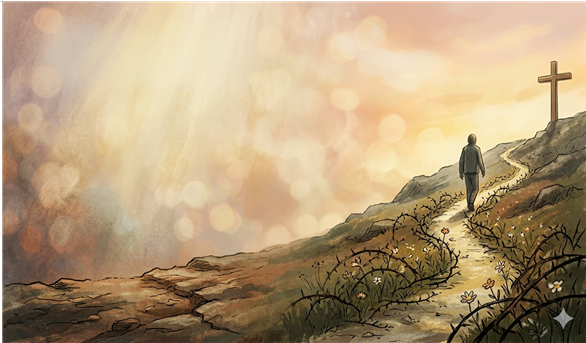
The path of righteousness contains both:
◾ fulfillment,
and
◾ suffering.
Both:
◾ flowers,
and
◾ thorns.
And Christians must consciously embrace this reality.
Blessed Are Those Who Hunger and Thirst
Therefore when Jesus says:
“Blessed are those who hunger and thirst for righteousness,”
He is not describing mild religious interest.
He is speaking about desperate longing.
The kind of longing stronger than comfort.
Stronger than success.
Stronger even than survival anxiety itself.
A longing to pursue the will of God revealed through Christ.
And this longing must shape both:
◾ our personal lives,
and
◾ our social lives.
Even when it becomes costly.
Even when misunderstood.
Even when criticized.
Even when suffering follows.
Therefore may we become people who hunger for righteousness more deeply than we hunger merely for comfort.
May we recover the passion to pursue the will of God revealed through Jesus.
And may we continue walking this path —
whether it leads through fulfillment,
or through suffering.
I pray this in the name of Jesus Christ,
who Himself walked the path of righteousness to the very end.