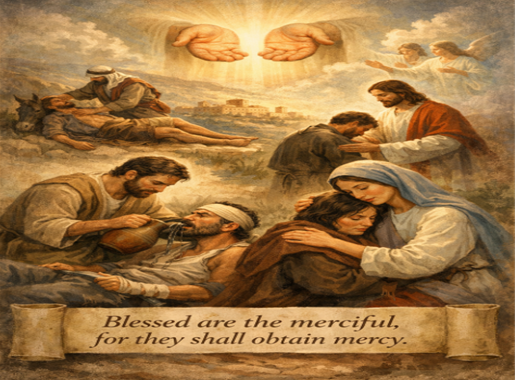
1 – Humanity Cannot Stand Without the Mercy of God
Matthew 5:7 declares:
“Blessed are the merciful, for they shall receive mercy.”
This verse belongs within the broader context of the Sermon on the Mount and, more specifically, within the section commonly called the Beatitudes. The Sermon on the Mount contains the ethical teachings Jesus gave to His disciples — not merely private spiritual instructions, but guidance for social and relational life within the kingdom of God.
The word translated as “blessed” comes from the Greek word makarios. More than simply describing a “fortunate person,” it refers to one who lives in a state of true happiness and flourishing. It describes a reality shaped by God Himself.
The expression “the merciful” comes from the Greek word eleēmones, a term often translated as “merciful” or “compassionate.” Yet behind this Greek expression stands a much deeper Old Testament background. In the Greek translation of the Old Testament, this word was frequently used to translate the Hebrew word raḥam.
The remarkable thing about raḥam is that its root refers to a mother’s womb.
In the Old Testament, this imagery became one of the most profound ways of describing the compassion of God. Just as a mother carries and protects a child within her womb, God embraces, sustains, and patiently bears His people. His mercy is not cold tolerance, but intimate, life-giving compassion.
This concept is often paired with another important Old Testament word: hesed, the covenantal love of God. Together, these two expressions portray the fullness of divine love — both the faithful love of a father and the nurturing compassion of a mother.
Particularly in contexts of forgiveness and restoration, these two themes appear side by side.
Thus, the mercy described in Matthew 5:7 is not simply emotional softness. It includes forgiveness, acceptance, patience, endurance, and the willingness to continue embracing others despite their weakness and failure.
What is especially significant in this Beatitude is its grammatical structure.
The latter half of the verse says:
“for they shall receive mercy.”
In the Greek text, the verb is written in the passive voice, yet the subject performing the action is unstated. In New Testament studies, this is often called the “divine passive.” The implied actor is God Himself.
In other words, the meaning is not:
“Merciful people will somehow earn mercy from others.”
Rather, the meaning is:
“God Himself will show mercy to the merciful.”
This same structure appears throughout the Beatitudes:
◾ Those who mourn will be comforted by God.
◾ The meek will receive inheritance from God.
◾ Those who hunger and thirst for righteousness will be filled by God.
◾ The pure in heart will see God.
◾ The peacemakers will be called sons of God.
Likewise, the merciful receive mercy from God Himself.
Yet Matthew 5:7 possesses a unique circular character among the Beatitudes.
The mercy that believers extend to others is not something produced merely from human strength or moral superiority. Rather, Christians show mercy because they themselves have already received mercy from God. We forgive because we have been forgiven. We endure because God continues to endure us. We patiently wait for others because God patiently waits for us.
Therefore, mercy is not simply an ethical action. It is the reflection of God’s own character within human life.
At the deepest level, every human being — especially every Christian — exists as one who constantly depends upon the mercy of God.
Our relationship with God is not sustained because of our achievements, moral perfection, or spiritual success. It continues only because God continues to forgive, embrace, accept, and patiently endure us.
Without the mercy of God, no one can stand before Him even for a single moment.
That is the foundation of the Beatitude:
“Blessed are the merciful, for they shall receive mercy.”
2- Humanity That Must Continually Seek Mercy
If human beings fundamentally live by the mercy of God, then Christians must continually seek that mercy throughout their lives.
Not for a single moment can a believer stand before God apart from His compassion.
This is because God is holy and righteous, while human beings remain incomplete, lacking, and broken. We are creatures marked by weakness and deficiency. Therefore, the Christian life is not sustained by self-confidence, but by continual dependence upon God’s mercy.
The New Testament repeatedly emphasizes this reality.
The Greek verb related to mercy, eleeō (“to have mercy”), appears frequently throughout the Gospels. Most often, it is connected to desperate cries directed toward Jesus.
Again and again, people cry out:
“Lord, have mercy on us.”
Blind men cry for mercy.
A Canaanite woman begs for mercy for her daughter.
A father pleads for mercy upon his suffering child.
Lepers lift their voices asking for mercy.
These passages reveal something essential about human existence.
Those who seek mercy are always people confronting some form of lack, brokenness, suffering, or helplessness. Mercy appears precisely within situations of deficiency.
In the Gospels, this is often expressed through physical sickness. Yet the meaning extends far beyond bodily illness.
Human beings suffer from many forms of poverty and brokenness:
◾ spiritual emptiness,
◾ emotional wounds,
◾ psychological exhaustion,
◾ material need,
◾ loneliness,
◾ despair,
◾ environmental hardship,
◾ and relational collapse.
All these conditions become places where the mercy of God is needed.
Therefore, seeking God’s mercy is not a sign of spiritual failure. It is one of the most honest acts of faith.
The Gospels do not portray people timidly requesting mercy in polite detachment. Rather, they cry out desperately and persistently. Their prayers are urgent because they recognize their own need.
Likewise, Christians are called to seek God’s mercy earnestly and continually.
We often imagine that once we become believers, we gradually move beyond the need for mercy. Yet the opposite is true. The more deeply one knows God, the more deeply one becomes aware of personal insufficiency and dependence upon divine grace.
The Christian life is not a journey away from mercy, but deeper into it.
For this reason, believers must constantly pray for the mercy of God:
◾ mercy that forgives,
◾ mercy that restores,
◾ mercy that strengthens,
◾ mercy that fills what is lacking,
◾ mercy that patiently sustains fragile lives.
Only through such mercy can human beings continue standing before God.
3- Extending the Mercy of God Into the World
Christians are called not only to receive the mercy of God, but also to extend that mercy toward others.
The reason believers must show mercy is simple:
we ourselves live by mercy.
We have been forgiven by God.
We have been accepted by God.
We continue to exist because God patiently endures us.
Therefore, mercy toward others is not optional for Christians. It is a responsibility, a calling, and even a vocation.
At its heart, mercy means freely giving to others what we ourselves freely received from God.
This mercy takes at least two important forms.
First, Christians are called to refrain from condemnation and harsh judgment.
Because God continues to forgive and patiently bear with us, believers must also learn to forgive, accept, and patiently endure others.
Significantly, the New Testament often uses the noun eleos (“mercy”) in passages where Jesus defends socially weak or marginalized people against religious condemnation.
Jesus says:
“I desire mercy, not sacrifice.”
He rebukes those who obsess over religious performance while neglecting compassion, justice, and faithfulness.
Mercy, therefore, stands against the spirit of self-righteous judgment.
The more deeply a person recognizes that he himself survives only by God’s patience, the more humble he becomes toward others.
Those who minister to others especially must remember this truth.
The apostle Paul explains that his ministry exists not because of his own worthiness, but because he himself first received mercy from God.
Thus, those who guide, teach, or care for others must never forget:
they too remain objects of God’s enduring patience.
Such awareness becomes the foundation for humility, gentleness, and endurance toward others.
Second, mercy involves caring for people living under various forms of deficiency and suffering.
Christians are called to comfort, encourage, support, and embrace those experiencing:
◾ material poverty,
◾ emotional exhaustion,
◾ psychological pain,
◾ spiritual weakness,
◾ physical suffering,
◾ or social isolation.
Yet such care must preserve the dignity of the other person. Mercy must never humiliate those who are already wounded.
True mercy protects the dignity and humanity of others even while helping them.
Ultimately, the Beatitude calls believers to live as visible reflections of God’s own character within the world.
Christians are people who remember:
◾ that they themselves constantly live under God’s patience,
◾ that they continually depend upon divine forgiveness,
◾ and that they survive only because of God’s sustaining compassion.
Therefore, they seek God’s mercy daily while also extending that same mercy into the lives of others.
And in doing so, the promise of Christ becomes reality:
“Blessed are the merciful, for they shall receive mercy.”
Prayer
Lord,
We confess that without Your mercy, we cannot stand before You even for a moment.
Yet how quickly we forget the grace we ourselves have received.
Too often, we judge others harshly while asking mercy for ourselves.
We forget that we, too, live only by grace.
Forgive us, Lord.
Teach us to remember our weakness,
to become people who show mercy as we have received mercy,
and to refuse pride that turns grace into something we claim as our own.
And for those who are weary, wounded, or burdened today,
may Your mercy draw near and hold them.
May we all become people who live by mercy and extend mercy to others.
We pray in the name of Jesus Christ,
who first showed us the mercy of God.
Amen.