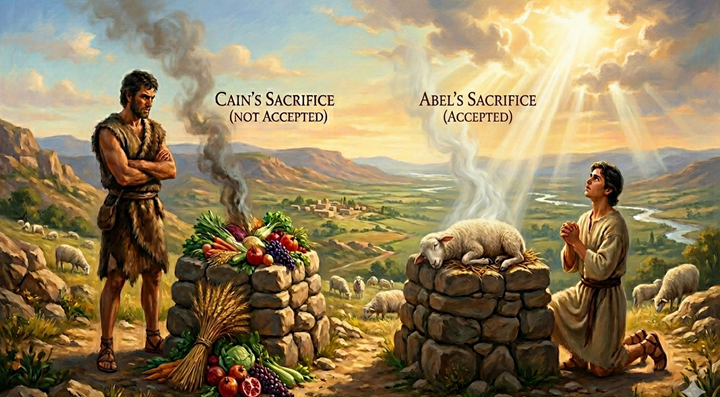
A Question Behind a Familiar Story
Some questions in Scripture are difficult to ignore. Among them is one of the most familiar—and puzzling—stories in the Book of Genesis: the offerings of Cain and Abel.
The question is simple.
Why did God accept Abel’s offering but reject Cain’s?
When reading Genesis 4, many readers naturally find themselves unsettled by the apparent contrast. Both brothers brought offerings before God. Cain presented produce from the ground, while Abel offered the firstborn of his flock along with their fat portions. Yet the outcome was strikingly different.
God accepted Abel and his offering, but Cain and his offering were not accepted.
The challenge is that the biblical text does not immediately explain why.
Instead, Genesis seems to leave readers with an unanswered question before moving forward with the narrative.
Within church tradition, one of the most common explanations has been this:
Cain’s offering was rejected because it consisted of grain, whereas Abel’s offering was accepted because it involved an animal sacrifice.
In other words, the problem supposedly lay in the type of offering itself. Since Abel brought a blood sacrifice and Cain did not, some conclude that God simply favored one over the other.
But is that explanation really sufficient?
A closer look raises important questions.
The Old Testament itself makes clear that God did not reject grain offerings in principle. In fact, the sacrificial system described in Leviticus explicitly includes offerings made from grain.
Leviticus 2 describes the grain offering, consisting of fine flour, oil, and frankincense, as a legitimate and accepted form of worship before God.
If God fundamentally rejected produce-based offerings, it becomes difficult to explain why such offerings were later incorporated into Israel’s worship.
For this reason, the idea that Cain’s offering was rejected simply because it consisted of crops does not seem fully convincing.
What, then, about another common explanation?
The New Testament appears to provide an important clue. In Hebrews 11:4, the writer states:
“By faith Abel brought God a better offering than Cain.”
(Hebrews 11:4)
For many readers, this verse seems to settle the matter. Abel’s offering was accepted because it was given in faith, whereas Cain’s was not.
Certainly, this explanation is important. Throughout Scripture, faith stands at the center of humanity’s relationship with God.
Yet even here, important questions remain.
What exactly does it mean to offer something “by faith”?
If faith was the decisive factor, how was that faith expressed? What made Abel’s offering an act of faith while Cain’s was not?
An even more intriguing detail emerges when we consider who Cain and Abel actually were.
Neither brother was spiritually ignorant. Genesis portrays Cain as someone who heard God’s voice and spoke directly with Him. In other words, Cain was not an outsider to divine relationship.
This makes the question even more difficult.
What, then, distinguished one brother from the other?
Why was one offering accepted while the other was rejected?
And perhaps more importantly:
What does this story reveal about what God truly sees?
Is worship ultimately about the form of the offering?
Its outward appearance?
Its material value?
Or is there something deeper that readers may have overlooked?
Interestingly, Genesis 4 seems to offer a subtle clue—one hidden in a remarkably brief phrase that many readers pass over too quickly.
“Abel and his offering”
“Cain and his offering”
Why does the text deliberately mention both the person and the offering?
Why not simply say that God accepted one offering and rejected the other?
Could it be that the story is directing our attention somewhere beyond the sacrifice itself?
If so, the real question may not simply be:
What was offered?
But rather:
Who was the one offering it?
In the next article, we will examine the wording of Genesis 4 more closely, including a key Hebrew expression, to explore what—or perhaps whom—God was actually looking at.