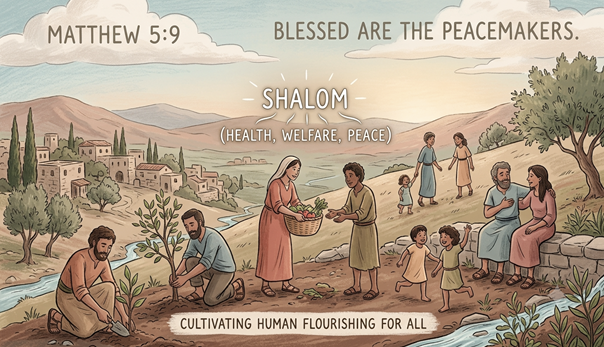
Text – 5:9
Creating Shalom in Our Time
In the previous reflections, we explored two important questions.
First, what does it mean to be called a son of God?
Second, what is the biblical meaning of peace?
We discovered that peacemakers are not merely peaceful people. They are those who actively participate in God’s work of restoring shalom.
This raises one final question:
What does it actually mean to create peace today?
What Does It Mean to “Make” Peace?
The Greek word translated “peacemakers” in Matthew 5:9 is eirēnopoioi (εἰρηνοποιοί).
The term is a compound word formed from eirēnē (“peace”) and poieō (“to make” or “to do”).
The significance of this second component deserves careful attention.
The verb poieō does not merely describe the production of an object. It often carries the broader sense of bringing something into reality through deliberate action.
For our purposes, two dimensions of the word are especially important.
The peacemaker is one who:
declares peace, and
produces peace.
Both are essential.
Declaring the True Nature of Shalom
To create peace begins with speaking truthfully about peace.
Throughout history, powerful individuals and institutions have often attempted to monopolize the blessings that God intended for all people.
As in the days of Rome, many continue to enjoy forms of health, welfare, security, and prosperity while denying those same opportunities to others.
The task of the peacemaker is therefore not merely private or personal.
It is also prophetic.
Peacemakers remind society of several fundamental truths.
First, the ultimate source of all blessing is God.
Human beings may possess wealth, influence, or power, but none of these originate from themselves.
Second, God’s gifts are intended for the flourishing of all people.
This does not eliminate effort, responsibility, or legitimate competition. Scripture never condemns diligence, excellence, or achievement.
Yet the Christian cannot remain indifferent when entire groups of people are systematically excluded from opportunities to flourish.
Whenever prosperity becomes the privilege of only a few, while others are denied access to the basic conditions of human dignity, something essential to God’s vision of shalom has been lost.
For this reason, peacemakers must continually proclaim what true peace actually is.
They remind the world that peace is not merely personal comfort.
Peace is the flourishing of human life under God’s gracious rule.
Producing Peace
Yet proclamation alone is not enough.
Peacemakers must also produce peace.
If declaring peace involves speaking truth, producing peace involves embodying truth.
Christians are called not only to critique systems that diminish human flourishing but also to participate in works that expand it.
This may take countless forms.
Some create opportunities through education.
Others contribute through business, medicine, science, public service, or ministry.
Still others offer encouragement, resources, mentorship, hospitality, or practical care.
The specific forms vary.
The underlying calling remains the same.
Wherever possible, followers of Christ are called to enlarge the sphere within which others may experience God’s shalom.
This means helping others encounter greater health, greater welfare, and greater peace.
The peacemaker does not ask,
“How much peace can I keep for myself?”
The peacemaker asks,
“How can God’s peace reach more people?”
A Vision Worth Pursuing
This truth carries particular significance for young adults who are still discerning the direction of their lives.
Many people pursue careers, education, influence, or financial stability as ends in themselves.
There is nothing inherently wrong with these pursuits.
Indeed, Christians should strive for excellence in whatever calling God places before them.
The deeper question is what we intend to do with what we receive.
Will success become a private possession?
Or will it become a means through which others experience blessing?
The kingdom vision presented by Jesus challenges us to think beyond personal advancement.
The goal is not merely to acquire shalom.
The goal is to participate in its expansion.
God invites human beings into His peace.
Likewise, those who have received God’s blessings are called to invite others into the sphere of peace they have helped create.
This is the vocation of the peacemaker.
The Honor Promised by God
In the Old Testament, the title “sons of God” was used with remarkable restraint.
In the New Testament, however, it becomes a promise.
Not a promise bestowed upon those who merely enjoy peace.
Not a promise given to those who remain passive.
Rather, it is a promise given to those who actively participate in God’s work of restoring and extending shalom.
Such people reflect the character of their heavenly Father.
Such people embody His purposes in the world.
And such people, Jesus says, are truly blessed.
For one day God Himself will acknowledge them as His sons.