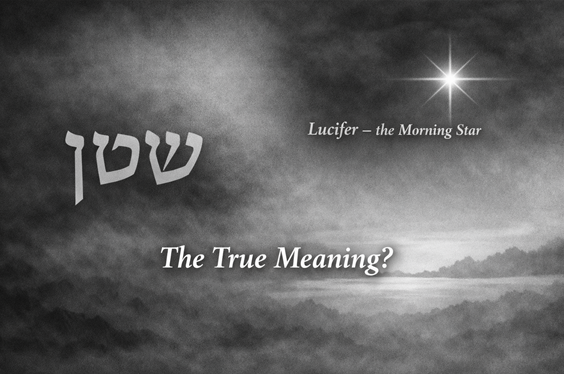
— The Biblical Meaning and Historical Development of the Term Satan
For many Christians, the word Satan immediately evokes the image of a fallen angel who stands in opposition to God. It is commonly assumed that Satan has always been the embodiment of evil and that the Bible consistently presents him in this way from beginning to end.
A closer reading of Scripture, however, reveals a more nuanced picture.
In the Hebrew Bible, satan was not originally used as the proper name of a specific supernatural being. Rather, it functioned as a common noun meaning “an adversary” or “an accuser.” Depending on the context, it could refer to a human opponent, a heavenly being, or simply someone acting in the role of an adversary.
The familiar image of Satan as the supreme enemy of God is therefore the result of a long process of theological and historical development rather than the original meaning of the term itself.
In this essay, we will first examine the Hebrew origin of the word satan and its usage throughout the Old Testament. We will then explore how the concept gradually developed within Israel’s historical experience.
1. The Original Meaning of Satan
The Hebrew noun śāṭān (שָׂטָן) is derived from the Hebrew verb śāṭan (שׂטן).
The verb simply means “to oppose,” “to resist,” or “to act as an adversary.” In the Old Testament it appears six times, describing the action of opposing or standing against another person.
From this verb comes the noun satan, which carries several closely related meanings depending on its context.
Among its most common senses are:
◾ an adversary
◾ an accuser
◾ a slanderer
One point deserves particular attention.
Originally, satan was not the personal name of an individual being. It was a functional term describing someone who opposed, accused, or resisted another.
In this respect, the word functioned much like titles such as king, judge, or messenger. It described a role before it identified a person.
Recognizing this distinction provides an important key for understanding how the concept of Satan developed throughout the biblical narrative.
2. How Is SatanUsed in the Old Testament?
The noun satan appears twenty-six times in the Hebrew Bible.
A careful examination of these occurrences reveals that the word is used in two primary ways.
Human Adversaries
In several passages, satan simply refers to a human opponent.
For example, the Philistine commanders feared that David might become “an adversary” during battle (1 Samuel 29:4).
David likewise described the sons of Zeruiah as acting as “adversaries” to him (2 Samuel 19:22).
During Solomon’s reign, both Hadad the Edomite and Rezon of Damascus are called “adversaries” whom God raised up against Israel (1 Kings 5:4 [Heb. 5:18]; 11:14, 23, 25).
The Psalms also use the term in the ordinary sense of an accuser or opponent (Psalm 38:20; 71:13; 109:4, 20, 29).
In all of these passages, satan carries no implication of a demonic or supernatural being. It simply describes someone acting in opposition to another.
Heavenly Adversaries
The same Hebrew word is also used for heavenly beings.
In Numbers 22:22, 32, the Angel of the LORD stands in Balaam’s path “as an adversary” (leśāṭān lô), preventing him from continuing his journey.
In Job 1–2, the Hebrew text uses haśśāṭān (“the adversary”) rather than a personal name, suggesting that the figure is presented primarily in terms of a role within the heavenly court.
A similar judicial role appears in Zechariah 3:1–2, where the satan stands to accuse Joshua the high priest.
Finally, 1 Chronicles 21:1 portrays Satan as inciting David to number Israel, marking one of the clearest examples in which the term begins to function as a more individualized figure.
These passages illustrate that the same Hebrew word can refer to heavenly beings performing an adversarial role, although its precise significance varies according to each literary context.
A Key Observation
In the Old Testament, satan is not consistently portrayed as the supreme embodiment of evil.
Instead, the word primarily describes the function of an adversary—a role that may be fulfilled by either a human being or a heavenly figure.
3. Was Satan Always the Embodiment of Evil?
At this point, an important question naturally arises.
If the Old Testament does not consistently portray Satan as the ultimate enemy of God, when did the familiar image of Satan as the embodiment of evil emerge?
Answering this question requires more than a study of vocabulary alone.
Biblical words do not develop in isolation. Like all language, they acquire richer meanings through the historical experiences of the communities that use them.
The concept of satan is no exception.
Throughout their history, the people of Israel endured repeated political, military, and religious crises. They struggled against surrounding pagan religions during the monarchy, experienced exile under Assyria and Babylon, returned from captivity under Persian rule, and later faced the cultural pressures of Hellenism before finally living under Roman domination.
These centuries of conflict profoundly shaped Israel’s theological reflection.
As the community wrestled with the reality of suffering, evil, and opposition to God’s purposes, the concept of satan gradually took on a broader and more personal dimension.
The historical development of this idea will be the focus of the next essay.
To Be Continued…
In the next installment, we will explore how the concept of Satan developed during the Second Temple Period and why the figure of Satan came to be understood as the personal embodiment of evil within later Jewish and Christian thought.