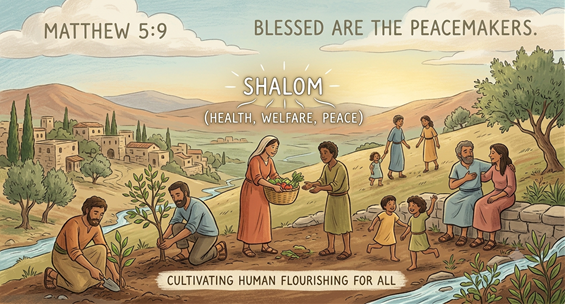
Text – Matthew 5:9
A. The Honor of Being Called Sons of God
“Blessed are the peacemakers, for they shall be called sons of God.” (Matthew 5:9)
This week’s sermon continues our study of the Beatitudes found in the Sermon on the Mount.
As we have noted in previous messages, the word translated “blessed” is the Greek term makarios (μακάριος), which refers to a person who is truly happy or living in a state of genuine flourishing.
Likewise, the phrase “they shall be called” reflects what scholars often refer to as the divine passive. In active form, the statement may be rendered:
“God will call them sons of God.”
Another feature worth noting is that the conjunction connecting the two clauses is omitted. The implied meaning is:
“Blessed are the peacemakers, because God will call them sons of God.”
To understand this promise properly, we must first examine what the expression “sons of God” meant within the biblical tradition.
The Meaning of “Sons of God” in the Old Testament
The expression “sons of God” (huioi theou) must be understood against the background of the Old Testament.
Throughout the Old Testament, God’s people are normally described as “My people” or “My inheritance.” By contrast, the title “sons of God” is used very sparingly, especially when referring to human beings.
In fact, the expression appears only a handful of times.
In the Book of Job, it is used of heavenly beings or angels (Job 1:6; 2:1; 38:7).
In Hosea 1:10, it appears as an eschatological promise concerning God’s future restoration of His people.
Why is the expression so rare?
The answer lies within a common Semitic idiom. In biblical thought, the phrase “son of” often indicates that a person shares the character, qualities, or status of the one named.
For example, when King Saul addressed David as “my son” (1 Samuel 24:16; 26:17, 21, 25), he was not merely expressing affection. The expression implicitly acknowledged David’s future role as Saul’s successor and participant in the royal household.
Against this backdrop, calling a human being a “son of God” becomes an extraordinarily significant statement. It implies participation in God’s character and, in some sense, a sharing in His status and dignity.
For this reason, the Old Testament uses the title with remarkable restraint.
A Distinctive Conviction of the Early Church
When we move into the New Testament, however, we encounter a dramatic change.
Expressions such as “sons of God” and “children of God” appear frequently throughout early Christian writings.
This development reflects a distinctive conviction of the early church, rooted in Jesus’ own teaching that His followers should address God as “Father.”
Unlike the surrounding religious culture, the first Christians understood themselves as belonging to God’s family in a uniquely intimate way.
Consequently, the promise found in Matthew 5:9 points to something far greater than a simple religious label.
To be called a son of God means to participate in God’s character and purposes. It signifies an elevation of human dignity and status granted by God Himself.
Yet Jesus presents this not as a present possession, but as an eschatological promise. God will ultimately acknowledge such people as His sons.
It is also worth noting that the New Testament overwhelmingly reserves the title “Son of God” for Jesus Christ Himself. More commonly, believers are called “children of God.”
Although the expressions differ, they communicate a closely related idea: a people who belong to God and reflect His character.
An Honor Earned Through Action
At this point we must ask an important question.
How does one receive this honor?
The New Testament repeatedly associates the identity of God’s children with concrete action rather than mere inward reflection.
This becomes especially clear in the Johannine writings, where the language of “children of God” emerges within contexts of persecution, opposition, and conflict.
The earliest Christians did not receive this title because they engaged in private contemplation or cultivated a purely inward spirituality.
Rather, they received it because they openly confessed their faith in Christ despite the cost.
In many cases, public identification with Jesus meant social rejection, economic hardship, or even death.
Yet they continued to live out their faith.
Their identity as God’s children was therefore connected to faithful action and visible commitment.
For this reason, being called a son or child of God is not merely a reward for holding correct beliefs internally. It is a spiritual honor associated with embodying God’s will in the midst of real-life circumstances.
The same principle applies to Matthew 5:9.
The promise is not directed toward those who passively enjoy peace.
Rather, it is directed toward those who actively pursue it, create it, and embody it through concrete action.
The peacemaker is not merely a peaceful person.
The peacemaker is a person who works for peace.
And it is such people whom God promises to call His sons.
B. Shalom and the World of Jesus
In Matthew 5:9, Jesus declares:
“Blessed are the peacemakers, for they shall be called sons of God.”
If the promise concerns those who actively pursue peace, we must ask another question:
What exactly is the peace they are called to make?
To answer this, we must look more closely at the biblical idea of peace itself.
The Rich Meaning of Shalom
The Greek word translated “peace” in the New Testament is eirēnē (εἰρήνη).
This word is commonly used to translate the Hebrew term shalom (שָׁלוֹם) in the Old Testament.
Unfortunately, many modern readers reduce peace to the mere absence of conflict.
Biblical shalom is far richer than that.
Throughout the Old Testament, shalom appears in a wide variety of contexts.
It can refer to physical well-being, prosperity, successful endeavors, harmonious relationships, social stability, peaceful relations among nations, and reconciliation with God.
Taken together, these dimensions may be summarized under three broad categories:
Health.
Welfare.
Peace.
Health refers not only to bodily well-being but also to emotional, psychological, and spiritual wholeness.
Welfare concerns the material conditions that sustain human life, including economic security and social stability.
Peace, in turn, is the quality of life that emerges when health and welfare flourish together.
In other words, shalom describes a condition in which human beings are able to thrive as God intended.
Therefore, when Jesus speaks of peacemakers, He is not referring merely to people who avoid arguments.
He is speaking of those who actively seek and cultivate the conditions under which genuine human flourishing becomes possible.
The peacemaker does not merely enjoy shalom.
The peacemaker works to create it.
The Hidden Assumption Behind Jesus’ Words
Jesus’ statement contains an important implication.
Whenever someone says,
“Blessed are the peacemakers,”
there is an unspoken assumption that peace is somehow absent, distorted, threatened, or monopolized.
Just as the command to love one another presupposes situations in which people fail to love one another, so the call to make peace presupposes a world where peace is lacking.
This means that Jesus’ audience would naturally have recognized several kinds of people standing in opposition to God’s vision of shalom.
Some sought to restrict the benefits of peace to a privileged few.
Others wished merely to enjoy peace without contributing to it.
Still others secured their own well-being at the expense of others.
Who were these people?
Who would Jesus’ listeners have imagined when they first heard these words?
Peace Under Empire
Within the historical setting of Jesus’ ministry, two groups stand out.
The first was the Roman Empire.
The second was the local aristocratic class that benefited from and collaborated with Roman rule.
The Romans famously spoke of the Pax Romana—the Peace of Rome.
Yet this peace came at a tremendous cost.
The prosperity and stability enjoyed by Rome were often built upon the labor, taxation, and exploitation of conquered peoples.
Land was confiscated.
Heavy taxes were imposed.
Labor was extracted.
Military service was demanded.
The empire’s peace depended upon structures that frequently deprived others of their own well-being.
At the same time, sections of the Jewish aristocracy, particularly those associated with the priestly elite, cooperated with Rome and shared in the benefits of the imperial system.
Together, these groups enjoyed the fruits of peace while restricting its blessings to those within their own circles of privilege and power.
Their version of peace was not universal.
It was selective.
It was exclusive.
And it was sustained through systems that often prevented others from experiencing the same blessings.
Another False Response
Yet there was another group as well.
On the opposite side stood revolutionary movements such as the Zealots.
Unlike Rome and its collaborators, these groups sought to recover what had been lost through active resistance and, at times, violent struggle.
Their goal was understandable.
They longed to reclaim the welfare, dignity, and freedom that had been taken from their people.
Yet Jesus did not simply endorse their methods.
As we observed in the previous Beatitude concerning the meek, Jesus consistently pointed toward a different path.
He rejected both imperial domination and violent retaliation.
Neither represented God’s kingdom.
Neither reflected God’s shalom.
When Jesus spoke of peacemaking, He was inviting His followers into an alternative vision of human flourishing—one that neither exploited others nor sought redemption through violence.
The Radical Vision of Jesus
This helps us appreciate how provocative Jesus’ words truly were.
To proclaim:
“Blessed are the peacemakers”
was not a sentimental statement about getting along with others.
It was a challenge to every distorted version of peace that existed in His world.
It challenged those who accumulated peace for themselves while denying it to others.
It challenged those who built prosperity upon exploitation.
It challenged those who believed violence could create lasting wholeness.
Jesus was announcing a radically different kingdom.
A kingdom in which peace is not hoarded.
A kingdom in which peace is not imposed.
A kingdom in which peace is shared.
The peacemaker, therefore, is not simply a peaceful individual.
The peacemaker is someone who participates in God’s work of restoring shalom to the world.
And it is such people whom Jesus calls blessed.
C. Creating Shalom in Our Time
In the previous reflections, we explored two important questions.
First, what does it mean to be called a son of God?
Second, what is the biblical meaning of peace?
We discovered that peacemakers are not merely peaceful people. They are those who actively participate in God’s work of restoring shalom.
This raises one final question:
What does it actually mean to create peace today?
What Does It Mean to “Make” Peace?
The Greek word translated “peacemakers” in Matthew 5:9 is eirēnopoioi (εἰρηνοποιοί).
The term is a compound word formed from eirēnē (“peace”) and poieō (“to make” or “to do”).
The significance of this second component deserves careful attention.
The verb poieō does not merely describe the production of an object. It often carries the broader sense of bringing something into reality through deliberate action.
For our purposes, two dimensions of the word are especially important.
The peacemaker is one who:
declares peace, and
produces peace.
Both are essential.
Declaring the True Nature of Shalom
To create peace begins with speaking truthfully about peace.
Throughout history, powerful individuals and institutions have often attempted to monopolize the blessings that God intended for all people.
As in the days of Rome, many continue to enjoy forms of health, welfare, security, and prosperity while denying those same opportunities to others.
The task of the peacemaker is therefore not merely private or personal.
It is also prophetic.
Peacemakers remind society of several fundamental truths.
First, the ultimate source of all blessing is God.
Human beings may possess wealth, influence, or power, but none of these originate from themselves.
Second, God’s gifts are intended for the flourishing of all people.
This does not eliminate effort, responsibility, or legitimate competition. Scripture never condemns diligence, excellence, or achievement.
Yet the Christian cannot remain indifferent when entire groups of people are systematically excluded from opportunities to flourish.
Whenever prosperity becomes the privilege of only a few, while others are denied access to the basic conditions of human dignity, something essential to God’s vision of shalom has been lost.
For this reason, peacemakers must continually proclaim what true peace actually is.
They remind the world that peace is not merely personal comfort.
Peace is the flourishing of human life under God’s gracious rule.
Producing Peace
Yet proclamation alone is not enough.
Peacemakers must also produce peace.
If declaring peace involves speaking truth, producing peace involves embodying truth.
Christians are called not only to critique systems that diminish human flourishing but also to participate in works that expand it.
This may take countless forms.
Some create opportunities through education.
Others contribute through business, medicine, science, public service, or ministry.
Still others offer encouragement, resources, mentorship, hospitality, or practical care.
The specific forms vary.
The underlying calling remains the same.
Wherever possible, followers of Christ are called to enlarge the sphere within which others may experience God’s shalom.
This means helping others encounter greater health, greater welfare, and greater peace.
The peacemaker does not ask,
“How much peace can I keep for myself?”
The peacemaker asks,
“How can God’s peace reach more people?”
A Vision Worth Pursuing
This truth carries particular significance for young adults who are still discerning the direction of their lives.
Many people pursue careers, education, influence, or financial stability as ends in themselves.
There is nothing inherently wrong with these pursuits.
Indeed, Christians should strive for excellence in whatever calling God places before them.
The deeper question is what we intend to do with what we receive.
Will success become a private possession?
Or will it become a means through which others experience blessing?
The kingdom vision presented by Jesus challenges us to think beyond personal advancement.
The goal is not merely to acquire shalom.
The goal is to participate in its expansion.
God invites human beings into His peace.
Likewise, those who have received God’s blessings are called to invite others into the sphere of peace they have helped create.
This is the vocation of the peacemaker.
The Honor Promised by God
In the Old Testament, the title “sons of God” was used with remarkable restraint.
In the New Testament, however, it becomes a promise.
Not a promise bestowed upon those who merely enjoy peace.
Not a promise given to those who remain passive.
Rather, it is a promise given to those who actively participate in God’s work of restoring and extending shalom.
Such people reflect the character of their heavenly Father.
Such people embody His purposes in the world.
And such people, Jesus says, are truly blessed.
For one day God Himself will acknowledge them as His sons.
Prayer
Lord, we thank You for the gift of shalom that You have graciously given to us.
Teach us not only to receive it with gratitude but also to share it generously with others.
Help us to become people who expand the reach of Your peace wherever we live, work, and serve.
May our lives reflect Your character and participate in Your purposes, so that we may be found worthy of the honor You have promised to Your children.
In the name of Jesus Christ, we pray.
Amen.