Part 1 — Why Bethel Matters
Rethinking the Setting of 2 Kings 2:23–25
Few passages in the Old Testament have generated as much discomfort as the brief account of Elisha and the bears in 2 Kings 2:23–25.
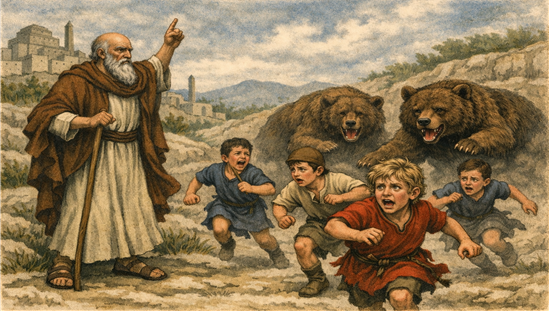
According to the traditional reading, the prophet Elisha was mocked by a group of small children because he was bald. In response, he cursed them in the name of the LORD. Two bears then came out of the woods and mauled forty-two of them.
Read this way, the story is deeply disturbing.
Why would a prophet respond so violently to childish teasing? And why would God allow such severe punishment simply because some children mocked a prophet’s appearance?
The story has therefore contributed to a long-standing image of Elisha as an unusually harsh and vindictive prophet.
But before we judge Elisha, there is a more fundamental question we need to ask:
Have we understood the setting of the story correctly?
The passage does not begin by telling us who the people were. It first tells us where Elisha went.
He went to Bethel.
That geographical detail may be far more important than it initially appears.
Bethel Was Not an Ordinary Town
The Hebrew name Bethel (בֵּית־אֵל) literally means “House of God.“
The name itself reflects the city’s ancient religious significance.
Long before the establishment of the monarchy, Bethel was already associated with some of Israel’s most important patriarchal traditions.
After Abraham entered the land of Canaan, he built an altar near Bethel (Genesis 12:8; 13:3–4). Later, Jacob stopped there while fleeing from his brother Esau. During the night, Jacob experienced his famous dream of a stairway reaching toward heaven and heard God’s promise concerning his descendants (Genesis 28:10–22).
When Jacob awoke, he recognized the significance of the place and named it Bethel—the “House of God.“
Thus, Bethel was not simply another settlement in the land of Israel. It was a place deeply connected with Israel’s ancestral memory of encountering God.
For generations, its name carried religious significance.
But the history of Bethel did not end there.
Its meaning changed dramatically with the division of the united monarchy.
From Sacred Memory to Northern Stronghold
After Solomon’s reign, the kingdom divided into two kingdoms: Judah in the south and Israel in the north.
Jeroboam, the first king of the Northern Kingdom, faced a serious political problem.
Jerusalem remained the religious and political center of the southern kingdom. The Temple was there, and the Ark of the Covenant was associated with Jerusalem. If the people of the Northern Kingdom continued to travel south to Jerusalem for worship, their religious loyalties could remain closely connected to the Davidic kingdom.
Jeroboam therefore needed religious centers of his own.
Bethel became one of them.
According to 1 Kings 12:26–33, Jeroboam established a sanctuary at Bethel and introduced a new religious system there. A golden calf was installed, priests were appointed, and alternative festivals were established.
Whatever one makes of the historical details surrounding these reforms, the narrative of Kings presents their significance very clearly:
Bethel became one of the principal religious centers of the Northern Kingdom.
This is crucial for understanding the story of Elisha.
Bethel was not merely a village through which a wandering prophet happened to pass.
It had become a place deeply associated with the religious and political order of the Northern Kingdom.
Why Does This Matter for Elisha?
Now return to 2 Kings 2.
Elisha has just experienced the dramatic departure of Elijah. Elijah, his master and predecessor, has been taken away, and Elisha has received his prophetic mantle.
After crossing the Jordan and performing a miracle at Jericho, Elisha travels toward Bethel.
Then the narrative tells us that, as he was going up toward the city, a group came out from Bethel and confronted him.
At this point, many readers immediately focus on the words translated as “little children.“
But that may be too soon.
Before asking who they were, we should first ask what Bethel represented.
The narrator could have simply told us that Elisha encountered a group of people on the road.
Instead, the place is specifically identified:
Bethel.
That location carries a long history—first as a place associated with the patriarchs and the memory of God’s revelation, and later as one of the principal religious centers of the Northern Kingdom.
That historical tension is important.
Bethel had once been associated with the ancestral memory of Israel’s relationship with God. By the time of the divided monarchy, however, it had become associated with the alternative religious system established by Jeroboam.
And it is precisely at this place that Elisha, the newly established successor of Elijah, encounters a hostile group.
That coincidence deserves our attention.
The Geography May Be Part of the Interpretation
Biblical narratives often communicate through more than the actions of their characters. Places can carry theological and historical meaning.
The significance of Jerusalem, Samaria, Shiloh, Hebron, and other cities cannot simply be separated from the stories in which they appear.
The same may be true of Bethel.
If we read 2 Kings 2:23–25 as though the event occurred in an ordinary village, the confrontation can easily be reduced to a simple personal incident:
A prophet was mocked by children because he was bald, became angry, and God punished the children.
But if Bethel was a major religious and political stronghold of the Northern Kingdom, another possibility begins to emerge.
Perhaps the narrator wants us to understand the encounter within the larger conflict between Yahweh’s prophet and the religious order represented by Bethel.
That does not yet tell us exactly who the people were.
Nor does it, by itself, explain the meaning of their words.
But it tells us that we should not rush to interpret the scene as nothing more than a prophet losing his temper over a childish insult.
Something larger may be taking place.
And this is where the next question becomes unavoidable.
Who exactly were the people who came out of Bethel?
Were they really the small children that English translations lead us to imagine?
Or does the Hebrew text allow us to see them differently?
That question requires us to move from geography to language.
And once we examine the Hebrew expressions translated as “little children,” the familiar picture of this story begins to look considerably less certain.
Conclusion
The story of Elisha and the bears has often been approached as though its meaning were immediately obvious.
A prophet was mocked.
Children were punished.
Two bears attacked them.
But the biblical narrative begins with something we may have overlooked:
Bethel.
The city was deeply rooted in Israel’s patriarchal traditions, yet by the time of Elisha it had become one of the principal religious centers of the Northern Kingdom established by Jeroboam.
That historical setting should shape the way we read the confrontation that follows.
The first step, therefore, is not yet to defend Elisha—or to condemn him.
It is simply to recognize that the location matters.
Before we decide what happened to the “children,” we need to discover who those people actually were.
That is where the Hebrew text becomes essential.