Part 2 — Who Were the “Little Children”?
Rethinking the Hebrew Words Behind the Story
In the previous essay, we looked at Bethel, the place where Elisha encountered the group that confronted him.
Bethel was not an ordinary village. It had deep roots in Israel’s patriarchal traditions, yet by the time of the divided monarchy it had become one of the principal religious and political centers of the Northern Kingdom.
That historical setting raises an important question.
Who, exactly, were the people who came out of Bethel and confronted Elisha?
The answer may depend on a phrase that has shaped the traditional interpretation of the entire story:
“little children.”
Were they really little children?
To answer that question, we need to move from geography to language and examine the Hebrew text itself.
What Do the Translations Say?
The Hebrew text of 2 Kings 2:23 describes the group as qĕṭannîm neʿārîm [qatanim naarim], a plural expression commonly translated as “little children,” “young boys,” or something similar.
The traditional translations naturally lead modern readers to imagine children—perhaps boys in their early teens or even younger.
English translations illustrate this tendency.
The King James Version has:
“little children”
The NRSV uses:
“small boys”
The NIV, however, translates the same group as:
“youths”
This difference is significant.
The English word children strongly suggests a particular age group in modern English.
But the Hebrew terms themselves may not be nearly so restrictive.
So we must ask:
What do these Hebrew words actually mean?
The First Word: Qāṭān
The word translated as “little” or “small” is the Hebrew adjective qāṭān (קָטָן).
Its basic meanings include such ideas as:
◾ small
◾ little
◾ young
◾ insignificant
◾ younger
At first glance, this seems to support the traditional interpretation.
But there is a problem.
When we examine the way qāṭān is actually used throughout the Hebrew Bible, we discover that it does not necessarily refer to a child.
Its meaning is often relational.
Someone may be called qāṭān because he is younger than another person, because he occupies a lower position, or because he is relatively insignificant within a particular relationship.
In other words, “small” does not necessarily mean “small in age.”
One striking example is Solomon.
In 1 Kings 3:7, Solomon describes himself before God as qāṭān after becoming king:
“I am only a little child; I do not know how to go out or come in.”
Yet Solomon was not an elementary-school child.
He was a young adult who had already ascended the throne of Israel.
The expression communicates his sense of inadequacy and relative youthfulness rather than identifying him as a literal child.
Another important example is Benjamin.
When Joseph’s brothers speak about Benjamin in Genesis, the word qāṭān is repeatedly used to describe him as the younger brother.
But Benjamin was already a mature man by this point, with a family of his own.
The word therefore tells us something about his relative position within the family, not simply his chronological age.
The same phenomenon appears elsewhere in the Old Testament.
Qāṭān can describe younger people, adults, and even people of considerable age when they are designated as the younger or lesser member within a particular relationship. The original survey of its occurrences in the Hebrew Bible likewise found numerous instances in which the term refers to adults rather than children.
So the first word already gives us reason for caution.
The Hebrew word for “little” does not require us to imagine little children.
The Second Word: Naʿar
The second word is even more important.
The Hebrew noun naʿar (נַעַר) is commonly translated as:
◾ child
◾ boy
◾ lad
◾ youth
But its semantic range is considerably broader.
Throughout the Hebrew Bible, naʿar can refer to children, but it can also describe servants, attendants, young adults, officials, and people serving in military contexts.
The original examination of its occurrences in the Hebrew Bible found an especially wide range of referents—from children and even those not yet born to mature adults. In the historical books, the term is repeatedly used for people who clearly cannot be understood as small children.
This is particularly important because the word can also be associated with people serving in subordinate or military roles.
That does not mean that every occurrence of naʿar refers to a soldier.
Far from it.
It means simply that the word itself does not tell us that the people in 2 Kings 2 were children.
Its meaning has to be determined from the context.
A Translation Can Create an Image
This brings us back to 2 Kings 2:23.
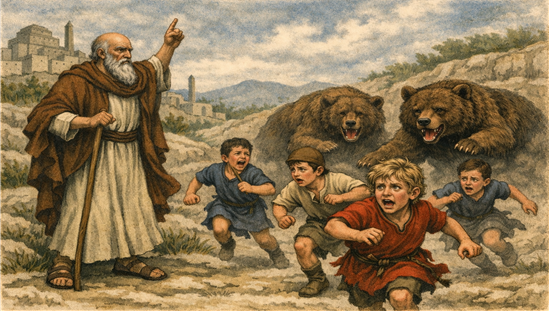
When modern readers encounter the phrase “little children,” a very specific image immediately forms in their minds:
a group of young boys,
perhaps ten or twelve years old,
running through the streets,
laughing at a bald prophet.
But that image does not come directly from the Hebrew vocabulary.
It comes partly from the way the vocabulary has been translated.
This distinction is crucial.
A translation is not necessarily wrong simply because it chooses the word “children.” The Hebrew words can certainly refer to children in other contexts.
The problem arises when we assume that the English translation has already settled the question of age and identity for us.
It has not.
The Hebrew words are broader.
And once that broader semantic range is recognized, the traditional picture becomes considerably less certain.
What Does the Hebrew Evidence Actually Prove?
At this point, we should be careful.
The linguistic evidence does not prove that the people who confronted Elisha were soldiers.
Nor does it prove that they were adults.
What it does prove—or, more precisely, what it allows us to say with considerable confidence—is something more modest but extremely important:
The Hebrew text does not require us to understand them as small children.
That distinction matters.
The traditional interpretation begins with the assumption that the group consisted of innocent children and then asks why Elisha would react so violently toward them.
But if the Hebrew terms themselves do not establish that assumption, then the entire argument must be reconsidered.
We are not yet saying who these people were.
We are saying that we cannot determine their identity simply by looking at the English word “children.”
That question must be answered by bringing the linguistic evidence into conversation with the historical and geographical setting we examined in Part 1.
From Language to Context
We can now put the two pieces of evidence together.
First, the event occurred atBethel, a major religious and political center of the Northern Kingdom.
Second, the Hebrew expression translated as “little children” is semantically broader than the English phrase suggests.
The words qāṭān and naʿar can describe people who are considerably older than the children modern readers normally imagine.
Therefore, the traditional picture is no longer inevitable.
The question has changed.
We no longer have to ask:
“Why did Elisha kill forty-two little children?”
We must first ask:
“Who were the people described by the Hebrew text as qĕṭannîm neʿārîm?”
That is a very different question.
And it leads us directly into the historical circumstances surrounding Bethel.
Conclusion
The story of Elisha and the bears has traditionally been built around a simple image:
a prophet, a group of children, a childish insult, and an apparently disproportionate punishment.
But the Hebrew vocabulary complicates that picture.
The word qāṭān does not necessarily denote a child. It can describe someone who is younger, lesser, or relatively insignificant within a particular relationship—even when that person is an adult.
The noun naʿar has an even wider range. It can refer to children, but also to young adults, servants, officials, and people serving in military contexts.
Consequently, the phrase traditionally translated as “little children” cannot by itself establish that Elisha was confronted by innocent children.
But this raises an even more important question.
If they were not necessarily children, then who were they?
The answer cannot be found in vocabulary alone.
We must return to Bethel—its political position, its religious function, and the kind of people who might have represented and defended such a city.
That is the question we will explore next.