Perhaps it was sometime in 1994.
One evening, I happened to watch a television documentary about Hinduism. Among everything it showed, one particular scene has remained vividly in my memory.
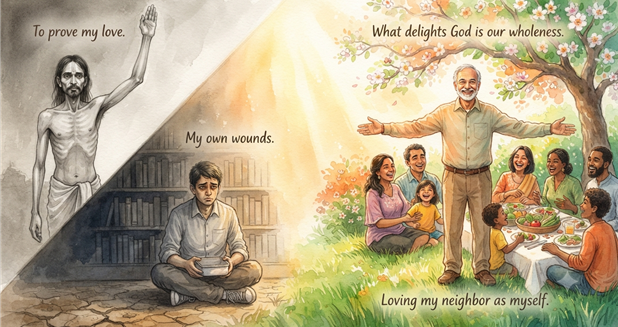
The documentary introduced a Hindu ascetic who had kept his right arm raised toward the sky for many years. According to the narrator, he had maintained that posture for nearly thirteen years. Because blood had long since ceased to circulate through his arm, it had eventually become permanently fixed in that position.
The interviewer asked him,
“Why have you chosen to live this way?“
The man answered quietly,
“To show my love and devotion to God.“
His sun-darkened face, his emaciated body, and above all, his lifeless arm stretched toward the sky left a profound impression on me. But even more striking than his appearance was the reason he gave.
For a long time, I could not forget what I had seen.
Countless questions filled my mind.
How could anyone endure such a life for thirteen long years? How could he withstand such relentless physical suffering?
At the same time, another question quietly emerged within me.
Would God truly delight in such devotion? Does God really desire people to express their love by harming their own bodies?
As the years passed, however, the vivid memory of that documentary gradually faded from my mind.
After completing my military service in 1993, I returned to university two years later, in 1995, as a second-year student.
I was a poor theology student. I had little that I could offer God in any tangible or material way. Yet one thing I had in abundance was a passionate love for God and a deep desire to devote my life to Him.
One day, while praying, a thought arose within me.
“Lord, I have nothing to give You. But I want to show You how deeply I love You and how devoted I am to You. For the next year, I will skip lunch every day and devote that time to reading Scripture, meditating on Your Word, and praying.“
Looking back, it was exactly the kind of prayer one would expect from someone captivated by the ideals and zeal of monastic spirituality. At the time, I not only believed that such a commitment was meaningful—I was fully convinced that I had the determination to carry it through.
And so, throughout 1995, I faithfully kept that commitment.
Every lunchtime I quietly went to the library, where I spent the hour reading the Bible, meditating, and praying instead of eating.
A year passed.
What, then, remained?
How would I evaluate that year of disciplined devotion, sustained by what I believed was sincere love for God?
The first thing it left me with was a weakened stomach. My digestion had noticeably deteriorated, and I began to experience ongoing health problems.
Having grown up in poverty, I had often skipped meals as a child. Later, while living alone as a student, I was still unable to eat properly on many occasions. Under those circumstances, adding a year of daily fasting at lunchtime placed an even greater burden on my body.
From that year onward, my digestive system became significantly weaker. I frequently suffered from indigestion, even after ordinary meals.
Remarkably, although its severity has lessened over the years, the effects of that decision have remained with me for nearly thirty years.
Yet the physical consequences were not the greatest shock.
Something else troubled me far more.
Despite a full year of disciplined fasting, prayer, and meditation, I found that I had made almost no progress in becoming a better person.
That realization was deeply humbling.
The journey had begun with genuine love for God and a sincere desire to express my devotion. The means I chose were daily fasting, meditation on Scripture, and prayer.
Yet when the year was over, I had to admit an uncomfortable truth.
It had not changed my character—not even a little.
I was still proud.
Still quick to judge others.
Still easily angered.
In many ways, I was the same person I had been before.
Holding the results of that year in my hands, I spent quite some time in quiet disappointment and bitter self-reflection.
Then, slowly, a realization began to dawn on me.
It began with a single question.
Had there been something fundamentally wrong with the very way I had tried to express my love for God and my devotion to Him?
Before long, an analogy came to mind—one that would remain with me ever since.
It was the relationship between parents and their children.
Suppose a young child were to come to his parents one day and say,
“Mom, Dad, you know how much I love you, don’t you? I want to show you just how much I love you. So, starting today, I’m going to stop eating.”
How would loving parents respond?
Surely they would be alarmed.
They would probably say,
“No, my child. That isn’t how you show us your love. What brings us the greatest joy is seeing you eat well, sleep well, grow strong, and live a healthy life. Please don’t try to prove your love by hurting yourself.“
Only deeply unhealthy parents would take pleasure in watching their child harm himself in an attempt to prove his love.
At that moment, I realized that the same must be true of our relationship with God.
Just as loving parents do not seek proof of their children’s love through their pain, neither does God seek proof of our love through our wounds or suffering.
From that point on, my perspective on asceticism changed.
Throughout much of Christian history, various forms of self-denial have been regarded as important expressions of devotion. During Lent, for example, many believers voluntarily practice self-restraint, giving up certain pleasures or embracing inconvenience as a way of expressing their love for and devotion to God.
I respect the sincerity behind such practices.
Yet today, I find myself asking a different question.
Does God really seek proof of our love through our wounds?
As the years passed, another question naturally followed.
Does God seek proof of our loyalty through the wounds of others?
At first glance, these may seem like two entirely different things.
One seeks to prove love for God through self-sacrifice.
The other seeks to prove loyalty to God by demanding sacrifice from others.
Yet the more I reflected on them, the more I realized that they share the same underlying assumption:
that someone’s suffering somehow brings pleasure to God.
But when I think of the heart of a loving parent, I find that assumption impossible to accept.
Loving parents do not delight in seeing their children harm themselves.
Nor do they rejoice when their children wound one another through hatred, conflict, or division.
What parents truly long for is to see their children healthy, flourishing, and living together in mutual love and respect.
I believe God is that kind of Father.
Jesus never separated love for God from love for one’s neighbor.
“Love your neighbor as yourself.“
Hidden within those words is an important truth.
Those who cannot cherish themselves often struggle to cherish others.
Likewise, a love for God that fails to love other people falls short of the kind of love Jesus taught.
Now, nearly thirty years later, I no longer seek to prove my love and devotion to God by harming my own body.
Nor do I believe that faithfulness to God is demonstrated by wounding others in His name.
Instead, I have come to believe that what delights God is not our wounds, but our wholeness.
To me, this is the truest—and perhaps the finest—way to love God.
And perhaps nothing brings greater joy to the heart of our heavenly Father than seeing His children live together in health, love, and mutual respect.