The Destiny of the Righteous and the Wicked
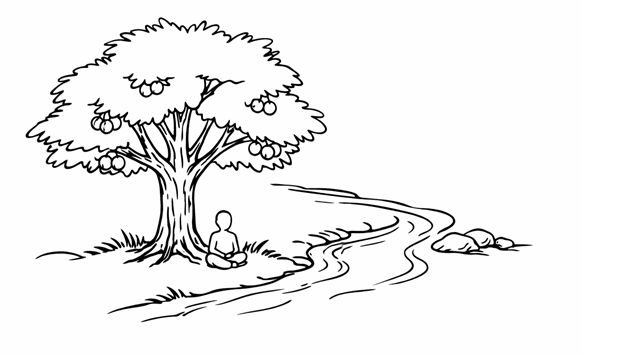
Like a Tree Planted by Streams of Water
Having described the way of the righteous, the psalmist now turns to its outcome.
That person is like a tree planted by streams of water, which yields its fruit in season and whose leaf does not wither—whatever they do prospers. (Psalm 1:3)
The image is striking.
In the modern world, trees are common enough that we often overlook their significance.
For the people of ancient Israel, however, this picture carried extraordinary force.
Much of the land was dry.
Rainfall was seasonal.
Water was precious.
To imagine a tree permanently rooted beside flowing water was to imagine stability, life, and enduring fruitfulness.
Notice that the psalmist does not compare the righteous to a wild tree that happened to grow there naturally.
It is a tree deliberately planted beside streams of water.
Its life is sustained by a constant source beyond itself.
Its strength is not self-generated.
Its fruitfulness is not accidental.
Everything depends upon where it has been rooted.
This is precisely the point.
The blessed life is not defined by the absence of hardship.
Trees beside streams still experience scorching heat.
They still endure changing seasons.
Yet they continue to flourish because their source of life remains secure.
The psalmist then turns abruptly to the opposite picture.
Not so the wicked! They are like chaff that the wind drives away. (Psalm 1:4)
The contrast could hardly be greater.
The righteous are compared to a deeply rooted tree.
The wicked are compared to chaff.
Unlike grain, chaff has no weight.
It has no roots.
It cannot resist even the gentlest wind.
It possesses movement but no direction.
Motion but no permanence.
The psalmist is not primarily speaking about earthly success or failure.
Indeed, elsewhere in the Psalms he openly acknowledges that the wicked often appear prosperous.
Rather, he is describing the ultimate character of a life.
One life possesses enduring substance because it is rooted in God.
The other lacks permanence because it is detached from its true source.
This contrast reaches its climax in the closing verse.
For the LORD watches over the way of the righteous, but the way of the wicked leads to destruction. (Psalm 1:6)
The Hebrew verb translated watches over is yadaʿ, one of the richest words in the Old Testament.
It means far more than intellectual awareness.
Throughout Scripture, yadaʿ often describes intimate knowledge, personal relationship, and covenantal concern.
The Lord does not merely observe the righteous from a distance.
He knows them.
He accompanies them.
He is personally concerned with their journey.
This truth transforms the entire psalm.
The promise is not that the righteous will never suffer.
Nor is it that they will always prosper according to human standards.
The promise is something deeper.
The One who gave them life continues to know them, guide them, and sustain them.
That is why the righteous can remain like a tree planted beside living water.
Their security does not rest in changing circumstances.
It rests in the enduring faithfulness of God.
Psalm 1 therefore leaves every reader with two images that cannot easily be forgotten:
A tree whose roots continually draw life from living water.
And chaff that disappears with the passing wind.
Every human life is moving toward one of these two destinies.
The decisive difference lies not in outward appearance, but in where one’s life is rooted.