Born within a class-based, hierarchical society,
the so-called noblesse oblige—
a phrase meaning
“the moral obligations that accompany high social status.”
In other words,
the elite of noble status are expected to set an example for those of other social classes through acts of self-sacrifice and devotion for the preservation and strengthening of the society to which they belong.
For example,
members of the British royal family have often volunteered for military service and, at times, served in war zones, thereby presenting themselves as examples to the people.
Yet
this idea can serve one purpose when directed toward the privileged class itself:
encouraging them to take the initiative in ways supposedly befitting their social status.
At the same time,
when presented to those who stand on the other side—
the “non-privileged”—
it can become a means of promoting the virtue of the privileged class’s own sacrifice and concessions.
And yet,
whenever I happen to encounter this idea in print, or whenever someone speaks of it
as though it were some lofty ideal or value that humanity itself must preserve,
I find myself once again reaffirming my sharply critical view of the concept embedded in this slogan.
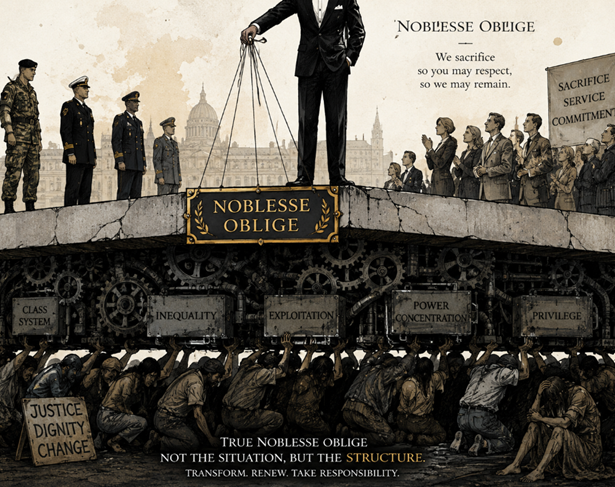
Without attempting to dismantle or fundamentally reform the social structure(!)
that has generated countless problems and, at the same time, has itself become
the source of those problems—
while the elites themselves occupy the upper levels of that very structure, and while they monopolize or control nearly all of the benefits that the structure produces—
they instead tend to be the very ones who created that structure,
who have contributed significantly to expanding its reach,
and who continue to work to preserve and maintain it.
And then,
as an action designed merely to renew a portion of the “absurd realities” and “injustices” produced by that very structure(!),
and usually only within the narrowest possible limits, there emerges noblesse oblige!
It therefore takes on something of the character of propaganda—
a form of hypocrisy
so carefully disguised,
so profoundly embedded,
that at times even those who practice it may be completely unaware of their own hypocrisy.
The situations in which those elites are expected to step forward under the banner or slogan of “noblesse oblige” already arise from within the structure that they themselves have built, or to whose construction they have contributed substantially, and which they continue to control.
Therefore,
the true noblesse oblige to which those elites ought to devote themselves should not be directed toward the situation but toward the structure itself.
In other words, true noblesse oblige should mean taking the initiative in transforming and renewing the structure itself.