Part 4 — Clearing Elisha’s Name
Rethinking the Bears of Bethel
For centuries, Elisha has carried one of the most disturbing reputations in the Old Testament.
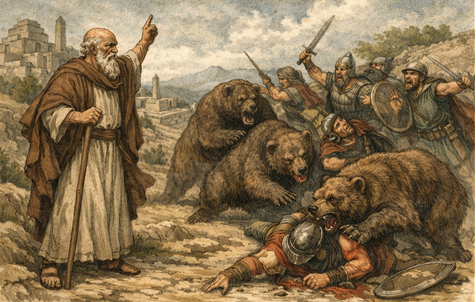
He is remembered as the prophet who became angry when children mocked his baldness, cursed them in the name of the LORD, and brought down divine punishment upon them. Two bears emerged from the woods and mauled forty-two of the children.
Read in this way, the story seems almost impossible to defend.
A prophet loses his temper.
Children pay with their lives.
And God appears to endorse the violence.
But after examining the story more carefully, we can now ask whether this familiar picture actually describes what happened at Bethel.
The problem may not lie primarily in Elisha’s actions.
It may lie in the way we have imagined the people who confronted him.
The Story We Have Inherited
The traditional reading begins with a very simple picture.
Elisha is walking toward Bethel.
A group of little children comes out of the city.
They see that he is bald and begin to mock him:
“Go up, thou bald head; go up, thou bald head.”
Elisha becomes angry.
He curses them.
Two bears appear.
Forty-two children are mauled.
Once this picture has been established in our minds, the moral judgment seems unavoidable.
But the previous three parts of this study have challenged almost every element of that picture.
The first question was where the event took place.
The answer was Bethel—a city with an ancient religious history that had become one of the principal political and religious centers of the Northern Kingdom.
The second question was who the people were.
The Hebrew words qāṭān and naʿar do not necessarily describe small children. Their usage extends to young adults and mature men, including people serving in official and military contexts.
The third question was therefore what kind of people might have been involved.
When the linguistic evidence is combined with Bethel’s geographical and political significance, the traditional picture becomes increasingly difficult to maintain.
The people who confronted Elisha may very well have been young men associated with the defense, security, or political establishment of Bethel—possibly soldiers.
If that is the case, the story changes completely.
From Children to Young Men
This is the crucial point.
We are not dealing with a minor difference in translation.
We are dealing with two completely different narratives.
In the traditional interpretation:
Elisha versus innocent children.
In the alternative interpretation:
Elisha versus a hostile group of young men associated with Bethel.
The first is a story about personal anger and disproportionate punishment.
The second is a story about prophetic confrontation within the religious and political conflict of the Northern Kingdom.
The difference could hardly be greater.
And the Hebrew vocabulary gives us reason to take the second possibility seriously.
The word qāṭān does not require childhood.
The word naʿar does not require childhood.
And the historical books of the Old Testament repeatedly use naʿar for adult men, including men connected with military and official activities.
The original examination of the biblical occurrences therefore provides an important foundation for reading the group in 2 Kings 2 differently.
The Importance of Bethel
The location makes the alternative interpretation even more significant.
Bethel was not an isolated village.
It had become one of the major religious centers established by Jeroboam after the division of the kingdom. Its location also gave it strategic importance in the northern part of the land.
A city occupying such a position would necessarily have people responsible for maintaining its political and physical security.
Thus, when the text tells us that the naʿarîm came out of the city, there is no need to imagine a group of children who simply happened to be playing on the road.
The setting allows another possibility.
These may have been young men belonging to the organized social world of Bethel—men whose presence and actions represented the city itself.
And if they were connected with the defense or security of Bethel, then their confrontation with Elisha would have had a very different meaning from a childish joke.
It could have been an act of hostile resistance.
“Go Up, Thou Bald Head”
The words themselves deserve another look.
“Go up, thou bald head; go up, thou bald head.”
Traditionally, these words are treated as nothing more than childish teasing.
But remember what has just happened.
Elijah, Elisha’s master, has been taken up.
Elisha has received the prophetic mantle.
He has crossed the Jordan.
He has already performed a miracle at Jericho.
And now he is going toward Bethel.
The command “Go up” therefore occurs in an unusually charged narrative setting.
It may certainly contain ridicule.
But it need not be reduced to ridicule concerning Elisha’s appearance.
The words may have functioned as a rejection of the prophet himself.
In other words:
“Go up.”
“Leave this place.”
“You do not belong here.”
“You have no authority here.”
If the people confronting Elisha were connected with the religious and political establishment of Bethel, their words may have represented something far more serious than childish mockery.
They may have been rejecting the authority of Yahweh’s prophet.
The Bears and the Judgment
There is another important distinction.
The text does not describe Elisha personally attacking the group.
He turns toward them and curses them in the name of the LORD.
Then the bears appear.
Whatever theological difficulties this passage raises, the narrative itself presents the subsequent attack as the consequence of the prophetic curse rather than as an act of personal violence carried out by Elisha.
This distinction matters.
If the group consisted of innocent children, the story appears to portray divine judgment as a response to childish ridicule.
But if the group consisted of hostile young men associated with the political or security structure of Bethel, the episode belongs to a very different category.
It becomes a story of prophetic judgment within the larger conflict between Yahweh and the religious system of the Northern Kingdom.
That does not make the story easy.
Nor should we pretend that every question about divine judgment has disappeared.
But it does remove one particularly damaging accusation:
that Elisha personally killed forty-two innocent children because they made fun of his baldness.
The evidence we have examined does not require us to accept that picture.
What, Then, Happened at Bethel?
We can now bring the evidence together.
First, the event took place at Bethel, a city of exceptional religious and political significance in the Northern Kingdom.
Second, the Hebrew words translated as “little children” do not necessarily refer to children. Both qāṭān and naʿar have much broader semantic ranges.
Third, naʿar is repeatedly used in the historical books for adult men and for people functioning in military or official capacities.
Fourth, the group came out of the city and confronted Elisha collectively.
Fifth, their repeated words and behavior appear hostile rather than merely playful.
Sixth, Bethel’s geographical and political character makes it highly plausible that young men associated with the city’s defense or security would have been present there.
Taken together, these observations offer a compelling alternative:
The people who confronted Elisha were very likely not small children but young men—possibly soldiers or guards associated with Bethel.
We should acknowledge the nature of this conclusion.
The biblical text does not explicitly say, “They were soldiers.”
Therefore, we should not turn an inference into an explicit statement of fact.
But neither should we do the opposite—turn a traditional translation into a certainty that the Hebrew text itself does not provide.
The question is not whether we can prove every detail of the reconstruction.
The question is whether the traditional image of forty-two innocent children being slaughtered because they mocked a bald prophet is actually demanded by the text.
It is not.
Clearing Elisha’s Name
For generations, Elisha has been remembered as a prophet who could not tolerate being mocked.
That image deserves to be reconsidered.
Perhaps the story was never about a prophet protecting his pride.
Perhaps it was about a prophet confronting opposition at Bethel.
Perhaps the people who confronted him were not helpless children but young men associated with a city that represented the religious and political order of the Northern Kingdom.
And perhaps the bears were not instruments of a prophet’s personal revenge but part of the narrative’s portrayal of divine judgment.
If so, then Elisha has been carrying an accusation that he may not deserve.
The traditional reading has transformed a complex prophetic confrontation into a simple morality tale:
A bald prophet became angry with children.
But the Hebrew vocabulary, the geography of Bethel, the historical setting, and the narrative context point toward a much more complicated picture.
The story may have nothing to do with a prophet’s wounded pride.
It may instead concern authority, religious allegiance, political power, and the confrontation between Yahweh’s prophet and the stronghold of an alternative religious order.
That is a very different story.
Conclusion
The purpose of rereading 2 Kings 2:23–25 is not to make a difficult biblical story disappear.
Nor is it to claim that every uncertainty has been resolved.
It is to question an interpretation that may have been imposed upon the text through translation and tradition.
The people called “little children” may not have been children at all.
The Hebrew vocabulary permits a much broader understanding.
The historical and geographical setting of Bethel strengthens that possibility.
And when these pieces are brought together, the evidence strongly suggests that the group may have consisted of young men associated with the city’s defense or security—possibly soldiers.
If that reconstruction is correct, then the traditional accusation against Elisha rests upon a profoundly misleading picture.
He was not a prophet who slaughtered innocent children because they mocked his baldness.
He was a prophet confronting a hostile group at Bethel, one of the principal strongholds of the Northern Kingdom.
The story remains difficult.
But perhaps the difficulty lies somewhere other than where we have traditionally placed it.
For too long, Elisha has been remembered as the prophet who called bears to maul children.
Perhaps it is time to read the story again.
And perhaps it is time, at last, to clear Elisha’s name.