Father, Mother
After forty years and twenty, a son nearing sixty finds himself longing to ask his parents—who lived what the world might call lives of failure—what it truly means to live, to endure, and to transcend despair.
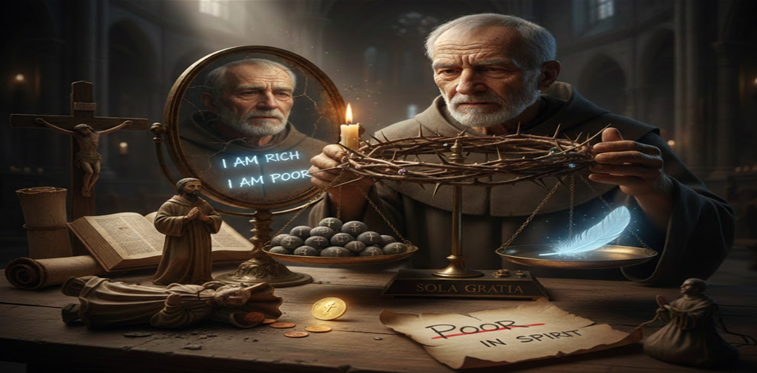
Why do Matthew and Luke describe the Beatitudes differently? Why does Luke proclaim, “Blessed are the poor,” while Matthew says, “Blessed are the poor in spirit”? This sermon explores the pastoral and theological logic behind those differences, confronting both materialistic faith and spiritual elitism. At the center stands a disturbing question: Which version of Jesus’ words makes us most uncomfortable?
Blessed Are the Poor and the Poor in Spirit (sermon) Read More »
What do Matthew’s “poverty of spirit” and Luke’s “poverty” reveal about us today?
By holding these two Beatitudes together, we confront a mirror that exposes both our trust in material security and our craving for spiritual superiority. This reflection explores how the Kingdom of God disrupts both forms of self-reliance—and why true blessedness begins in discomfort.
“Poverty and Poverty of Spirit” – 4 Read More »
Contempt cannot be directed toward nothingness.
To despise is already to assume existence.
In this sense, contempt is not the absence of faith,
but a different way of facing the same object.
Even denial, when charged with contempt,
quietly testifies to conviction.
Contempt and Its Object — God Read More »
To You,
a span of a thousand years
is no more than a single day.
But to me,
that single day
is a thousand years of time.
A Thousand Years (A Confessional Reflection) Read More »
Can spiritual devotion become a barrier to God? In Part 3, we explore Matthew’s “poverty of spirit” as a radical critique of spiritual elitism. This post deconstructs the hidden pride of the “religious overachievers” and defines true spiritual bankruptcy. Through a candid personal reflection on the trap of religious ego, discover why being “poor in spirit” is not optional—but the only way to inherit the Kingdom of Heaven.
“Poverty and Poverty of Spirit” – PART 3 Read More »
The titles “Brother” and “Sister” in the early church were not mere greetings; they were revolutionary declarations that shattered the Roman social hierarchy. Author Jo Bee Soo provocatively suggests stripping away modern church titles that have become new castes and returning to the original horizontal order of Christ.
Brothers and Sisters: A Title that Shatters Status and Caste Read More »
What does it mean to call a “beggar” blessed? In this second part of our series, we delve into the radical social critique of Luke’s version of the Beatitudes. By exploring the original Greek term ptōchos, we confront the sharp tension between the Kingdom of God and “Prosperity Theology.” Discover why Jesus’ words remain a profound discomfort for both modern seekers of wealth and those who equate faith with material success.
“Poverty and Poverty of Spirit” – PART 2 Read More »
Why did Christianity reject the interpretive convenience of Dualism in order to affirm the material world?
This essay explores the sacred refraction introduced by the Incarnation and the fateful task of theology: to interpret a world marked by both divine goodness and undeniable suffering.
Why do Matthew and Luke record Jesus’ Beatitudes differently?
Is it a simple discrepancy, or a profound theological intention?
This post explores the “Preacher’s Wisdom” behind the Gospels, revealing how the biblical writers contextualized the message of the Kingdom for their specific audiences. By examining ancient currency units and socioeconomic backgrounds, we discover why attention to the audience is the key to unlocking the true meaning of “blessedness.”
“Poverty and Poverty of Spirit” – Part 1 Read More »