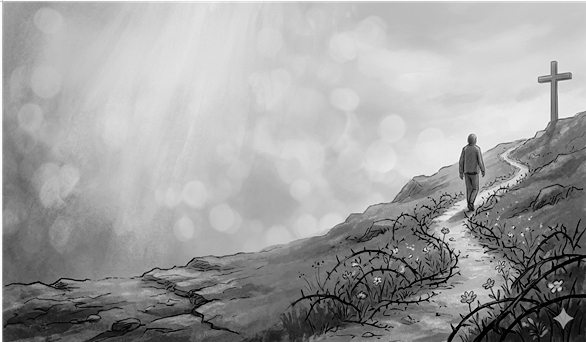
Text – Matthew 5:6
Jesus does not use mild language in this verse.
The words “hunger” and “thirst” in the original Greek do not describe ordinary desire. They refer to extreme conditions—a level of deprivation where survival itself is at stake.
This kind of hunger simplifies everything.
When a person is truly starving or desperately thirsty, the world is reduced to one urgent reality:
◼ Before satisfaction
◼ After satisfaction
Nothing else matters in that moment. Not success, not morality, not long-term goals. Only one thing remains: the need to survive.
This is what makes Jesus’ statement so radical.
He takes words that describe the most primal human instincts and connects them to something unexpected:
righteousness—living according to God’s will.
This means that Jesus is not calling for casual interest or occasional effort.
He is calling for something far deeper:
A desire for God’s will that rises to the level of instinct.
For His original audience—many of whom lived in poverty and constant uncertainty—this would not have sounded comforting. It would have sounded difficult, even unsettling.
And the same is true today.
We live in a world where survival still shapes our priorities:
financial stability
career advancement
security and comfort
These are not wrong. In fact, Jesus Himself acknowledges the necessity of “bread” in Matthew 4:4. Human beings do need material provision.
The issue is not whether we pursue these things.
The issue is what comes first.
In Matthew 6:33, Jesus makes this clear:
“Seek first the kingdom of God and His righteousness…”
This is not a rejection of material needs.
It is a reordering of priorities.
The danger is that we begin to treat survival as everything, pushing the pursuit of God’s will into the background. When that happens, righteousness becomes optional—something we pursue only when convenient.
But Jesus reverses this logic.
The pursuit of God’s will is not secondary to life—it is central to it.
And this leads to an uncomfortable but necessary question:
Are we truly living differently?
Christians do not exist in isolation. We live alongside others—people of different beliefs, philosophies, and moral systems. Many of them pursue lives marked by sincerity, discipline, and ethical commitment.
This leads us to an important clarification.
Righteousness, as Jesus speaks of it, is not merely an internal or private matter. It is not something that exists only in the hidden realm of personal spirituality. It is visible, embodied, and therefore comparable.
Jesus makes this explicit in Matthew 5:20:
“Unless your righteousness surpasses that of the scribes and Pharisees, you will certainly not enter the kingdom of heaven.”
This statement changes everything.
The Pharisees were widely recognized as the most devoted and disciplined practitioners of the law. They represented the highest visible standard of religious life in their society.
And yet, Jesus sets the bar even higher.
This means that righteousness is not only about personal devotion—it inevitably takes on a relational and social dimension. It appears in the way one lives among others, and as such, it is unavoidably seen, evaluated, and even compared.
In other words:
The life of righteousness is lived within a field of comparison.
So the question is not abstract. It is deeply practical:
Are we more honest?
More just?
More loving?
More faithful in action?
If we answer honestly, the response is not always clear.
And perhaps the reason is this:
We have learned to hunger for survival more than we hunger for righteousness.