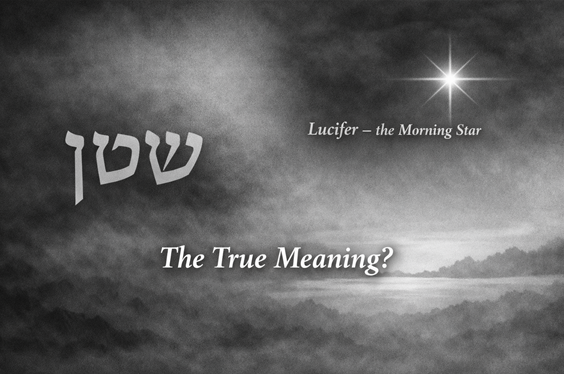
— A Biblical Reexamination of “Lucifer“
Among the many names associated with Satan, none is more familiar than Lucifer.
Popular culture, Christian tradition, and countless sermons have identified Lucifer as the original name of the fallen angel who rebelled against God.
Yet a careful reading of Scripture reveals an intriguing fact.
Nowhere does the Bible explicitly identify Lucifer as Satan’s personal name.
How, then, did this association become so widespread?
To answer that question, we must first examine the origin of the word itself.
1. The Original Meaning of Lucifer
Contrary to popular assumption, Lucifer is not a Hebrew word.
It is Latin.
Derived from lux (“light”) and ferre (“to carry” or “to bring”), the word literally means “light-bearer.“
In classical Latin it referred simply to the Morning Star—the planet Venus appearing before sunrise.
Originally, therefore, Lucifer carried no inherently negative or demonic meaning.
It was simply the ordinary Latin designation for the morning star.
2. Why Does the Word Appear in the Bible?
The word entered biblical tradition through Jerome’s Latin translation of the Bible, the Vulgate.
While translating Isaiah 14, Jerome rendered the Hebrew expression describing the morning star with the familiar Latin word Lucifer.
This was a straightforward translation rather than the introduction of a new theological concept.
Nothing in Jerome’s translation necessarily implies that he intended Lucifer to function as Satan’s proper name.
3. How Did Lucifer Become Associated with Satan?
The widespread identification of Lucifer with Satan developed gradually within Christian interpretation.
One important influence came from Luke 10:18, where Jesus declares,
“I saw Satan fall like lightning from heaven.“
Early Christian interpreters often read this saying alongside Isaiah 14, understanding the fallen morning star as a symbolic description of Satan’s fall.
Later traditions concerning fallen angels, many of which developed during the Second Temple Period, reinforced this interpretation.
Over the centuries these ideas merged into the now-familiar image of Lucifer as the original name of Satan.
A Key Observation
The identification of Lucifer with Satan reflects a long history of theological interpretation.
It should not be confused with an explicit statement made by the biblical text itself.
4. The Morning Star in the New Testament
One observation deserves special attention.
The New Testament also applies the title Morning Star to Jesus Christ.
In Revelation 22:16 Jesus declares,
“I am the bright Morning Star.“
This demonstrates that Morning Star is not inherently a title for Satan.
Rather, it is a symbolic image whose meaning depends entirely upon its literary and theological context.
Consequently, the appearance of the phrase “morning star” should not automatically be interpreted as a reference to Satan.
5. Which Name Does Scripture Actually Use?
Throughout both the Old and New Testaments, the consistent biblical designation for God’s adversary is Satan.
By contrast, Lucifer owes its prominence largely to the history of biblical translation and subsequent Christian interpretation.
This observation does not invalidate centuries of Christian tradition.
Instead, it encourages us to distinguish carefully between what Scripture explicitly says and how later theological reflection came to understand it.
Conclusion
Biblical interpretation often involves distinguishing between the language of Scripture itself and the traditions that later grew around it.
The history of Lucifer illustrates this principle well.
Understanding how the association between Lucifer and Satan developed enables us to appreciate both the richness of Christian tradition and the importance of returning continually to the biblical text itself.
Historical investigation does not diminish faith.
Rather, it helps us read Scripture with greater clarity, greater humility, and deeper appreciation.